Category: Business & Funding

Robotics runs on capital, and the funding rounds tell you where the industry actually believes it is going — often more honestly than the product launches do. This is our coverage of the money: Series A through late-stage rounds, strategic investments from automakers and chipmakers, acquisitions and consolidation, factory build-outs, hiring and relocation, and the occasional down round or quiet shutdown. We report the numbers as stated, name the lead investor where it is disclosed, and note when it is not. Where a round funds something concrete — a plant sized for 30,000 units a year, a compute deal measured in GPUs — we say what that capacity implies and what still has to be true for it to pay off. Robotics has a long history of announced capacity that never ships, so we treat a funding announcement as a statement of intent, not an accomplishment.

  • Robotics Recap: Saab Launches a Robot Sub, Fugro Gets €150M for USVs, Atlas Builds in a Day and Origin Raises $20M

    Robotics Recap: Saab Launches a Robot Sub, Fugro Gets €150M for USVs, Atlas Builds in a Day and Origin Raises $20M

    By Zip Robotic · October 18, 2026

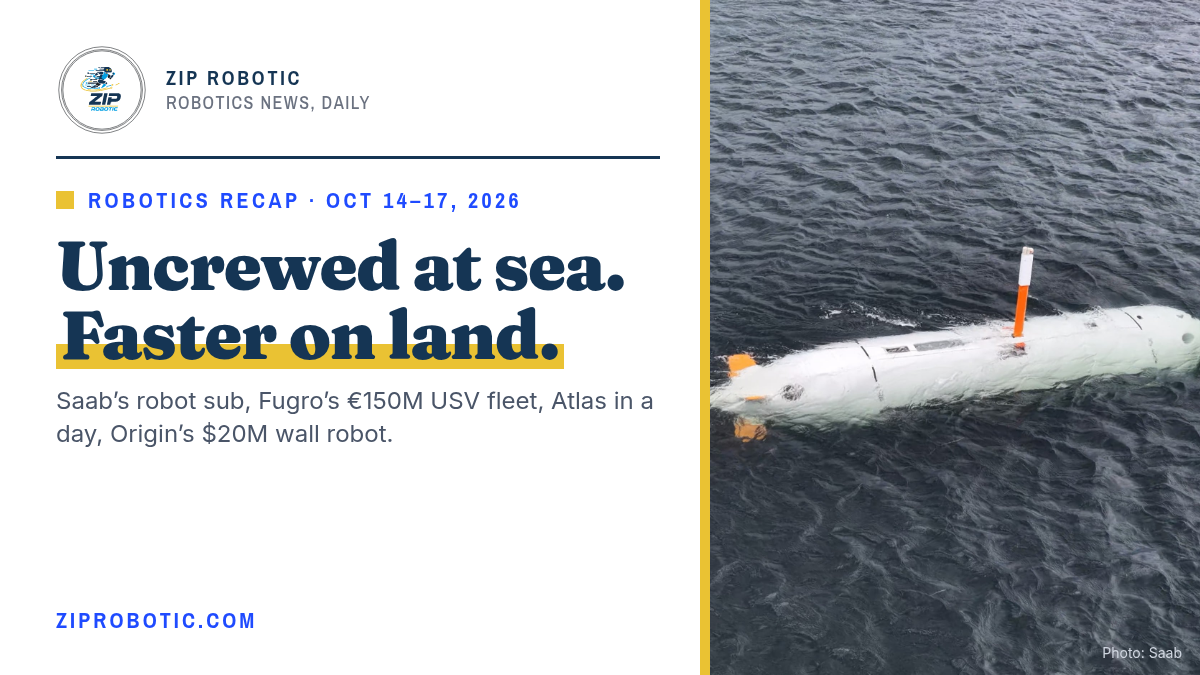
    Four stories from October 14–17, one theme: uncrewed at sea, faster on land. Sweden got a large robot submarine from contract to sea trials in under a year. Fugro lined up €150 million to put up to 25 more remotely operated survey boats on the water. Boston Dynamics put a number on how long it takes to build an Atlas. And a construction startup came out of stealth with a robot that finishes walls on live job sites.

    1. Saab launches a large robot sub in under a year

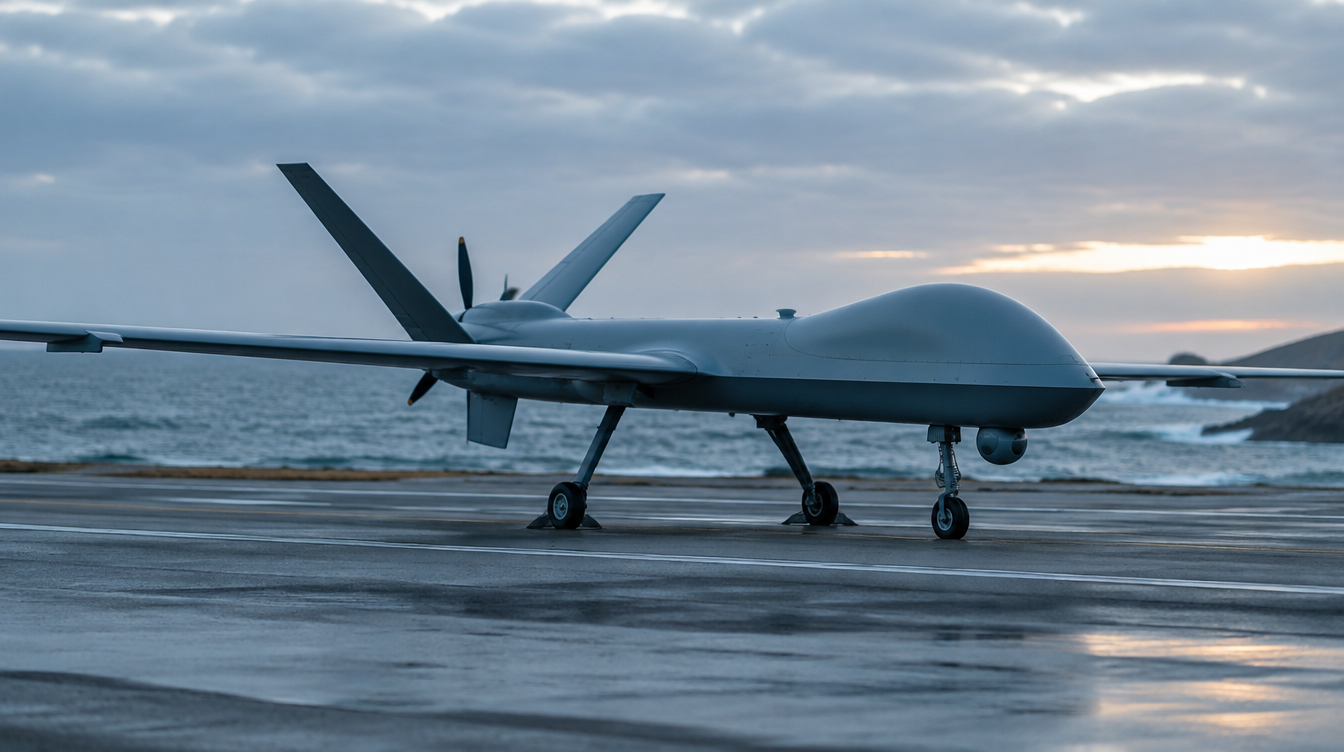
    Saab, the Swedish Defence Materiel Administration (FMV) and the Swedish Armed Forces have developed, built and launched a demonstrator for a Large Uncrewed Underwater Vehicle (LUUV) less than one year after contract award, Saab said on October 16. Following successful sea trials, the first phase of the project is complete; the next phase is expected to focus on more advanced capabilities.

    Saab credits the pace to its software-centric approach and to Autonomous Ocean Core, its autonomous control system for surface and subsurface vehicles, combined with Swedish submarine design and sensor-integration expertise. The demonstrator is meant to support evaluation of future underwater capabilities and to operate alongside existing naval platforms such as submarines. FMV now leads the project with the Armed Forces and Saab, and the results will feed Swedish decisions on whether and how to buy autonomous underwater systems.

    “The fact that we have also been able to develop and test the system in such a short timeframe demonstrates the strength of the collaboration between the Swedish Armed Forces, FMV and Saab,” said Mats Wicksell, head of Saab’s business area Naval.

    Why it matters: Navies have spent years talking about large uncrewed subs. Contract to sea trials in under twelve months is a software-speed timeline for a hardware program, and it comes the same week the U.S. Navy deployed the Seahawk USV with a carrier strike group.

    Source: Saab press release, Oct 16, 2026

    2. Fugro gets €150 million for up to 25 robot survey boats

    The European Investment Bank has signed a €150 million unsecured financing facility with Fugro, the Dutch geo-data company that surveys the seabed for offshore wind farms, subsea cables and other marine infrastructure, the two announced on October 14. The money supports the development and deployment of Fugro’s uncrewed surface vessel (USV) technology and the phased expansion of its remote operations.

    According to the EIB, the financing enables the deployment of up to 25 new medium-sized, long-range, remotely operated USVs for seabed surveys, site assessments and offshore asset monitoring, plus research into remote sensing and underwater robotics. Paired with underwater robots, the boats let Fugro send subsea data to remote operating centres in real time. The EIB says Fugro’s USVs cut fuel consumption by up to 90% compared with traditional survey vessels. Eligible costs run from January 2025 through December 2031, with drawings of up to 10 years.

    “Uncrewed surface vessels and remote operations are an important part of our long-term strategy – enhancing safety, reducing carbon emissions and improving operational efficiency,” said Fugro CEO Mark Heine.

    Why it matters: “Up to 25” is a programme ceiling, not a purchase order, but it is a public development bank underwriting a commercial robot fleet. Offshore wind and cable work runs on survey data, and this is a bet that most of it will be collected without a crew aboard. It’s the same direction as Ørsted’s cargo-drone trial at Hornsea 2.

    Sources: Fugro press release, Oct 14, 2026 · EIB press release, Oct 14, 2026

    3. Boston Dynamics says an Atlas now takes about a day to build

    In a roughly six-minute video published October 14, Machine, Assemble, Repair: How We Build Atlas, Boston Dynamics walks through the prototype operations floor where it machines, assembles and repairs its humanoid. Senior Technical Program Manager Katie Conner says building a robot now takes about a day, with an ambition of roughly an hour next year and minutes after that.

    Machinists in the video explain why precision work, including gear cutting, stays in-house: engineers can walk down to the shop, change a design and have revised parts the same day or the next. Staff describe robotic arms built into assembly and a loop that can take an idea from Monday to implementation by the end of the week. Boston Dynamics frames the goal as “manufacturing velocity.”

    Why it matters: The humanoid race is now a manufacturing race. Note what the number measures: the time to build one robot on a prototype floor, not a production line’s output rate, and the hour is a target, not a result. Context: Boston Dynamics named a new CEO earlier this month and is preparing Atlas for Hyundai’s plants.

    Source: Boston Dynamics on YouTube, Oct 14, 2026

    4. Origin raises $20 million for a robot that finishes walls

    San Francisco-based Origin came out of stealth on October 15 with $20 million in total funding co-led by Accel and Zacua Ventures, with angel investors from Anduril, Skild AI, 1X and Tesla. Its flagship robot, OG-1, autonomously handles wall finishing on live job sites: it applies compound, sands and primes, works at heights of up to 14 feet and uses real-time force control to keep even pressure on the wall. It runs on what Origin calls a Construction Action Model, trained in simulation and on deployment data.

    The money goes toward building out the OG-1 fleet and pilots, including with two of the largest drywall finishing contractors in the U.S., with more scheduled in Germany, Sweden, France and Saudi Arabia. Origin is targeting 150 robots deployed by the end of 2027 and says its robots already work at three times human speed. That’s the company’s claim, not an independent measurement.

    Why it matters: Origin says interior work makes up more than 65% of construction timelines and is still done mostly by hand. Mechanization so far has focused on heavy exterior work, so a robot that finishes walls next to working crews is aimed at the bigger share of the labor gap.

    Source: Origin press release, Oct 15, 2026

    The pattern

    Below the surface, on the build floor, on the job site. Two marine fleets got real money or real sea time, and two land robots got judged on throughput: how fast you can build one, and how fast it can do a trade. Which move matters most? Tell us on X @ZipRobotic.

    Roundups every Wednesday and Sunday at ziprobotic.com.

    Sources

    • Saab, “Saab, FMV and the Swedish Armed Forces launch uncrewed underwater vehicle,” Oct 16, 2026 — https://www.saab.com/newsroom/press-releases/2026/saab-fmv-and-the-swedish-armed-forces-launch-uncrewed-underwater-vehicle
    • Fugro, “Fugro secures long-term funding with new facility from the European Investment Bank…,” Oct 14, 2026 — https://www.fugro.com/news/press-releases/2026/fugro-secures-long-term-funding-with-new-facility-from-the-european-investment-bank-and-two-year-extension-of-existing-senior-debt-facilities
    • European Investment Bank, “EIB boosts sustainable development of geo-data experts Fugro,” Oct 14, 2026 — https://www.eib.org/en/press/all/2026-335-eib-boosts-sustainable-development-of-geo-data-experts-fugro
    • Boston Dynamics, “Machine, Assemble, Repair: How We Build Atlas,” YouTube, Oct 14, 2026 — https://www.youtube.com/watch?v=dP_i7hRvGpE
    • Origin, “Origin Emerges From Stealth With $20 Million to Build General-Purpose Robots for Construction,” Oct 15, 2026 — https://origin.tech/blog/origin-emerges-from-stealth-with-20-million

    Images: Saab (LUUV), Fugro (USV), Boston Dynamics (video still), Origin (founders). Used from each company’s own press materials.

  • Agility Robotics Clears SEC Step Toward Nasdaq Listing as “AGLT”; Shareholder Vote Set for Nov. 2

    Agility Robotics Clears SEC Step Toward Nasdaq Listing as “AGLT”; Shareholder Vote Set for Nov. 2

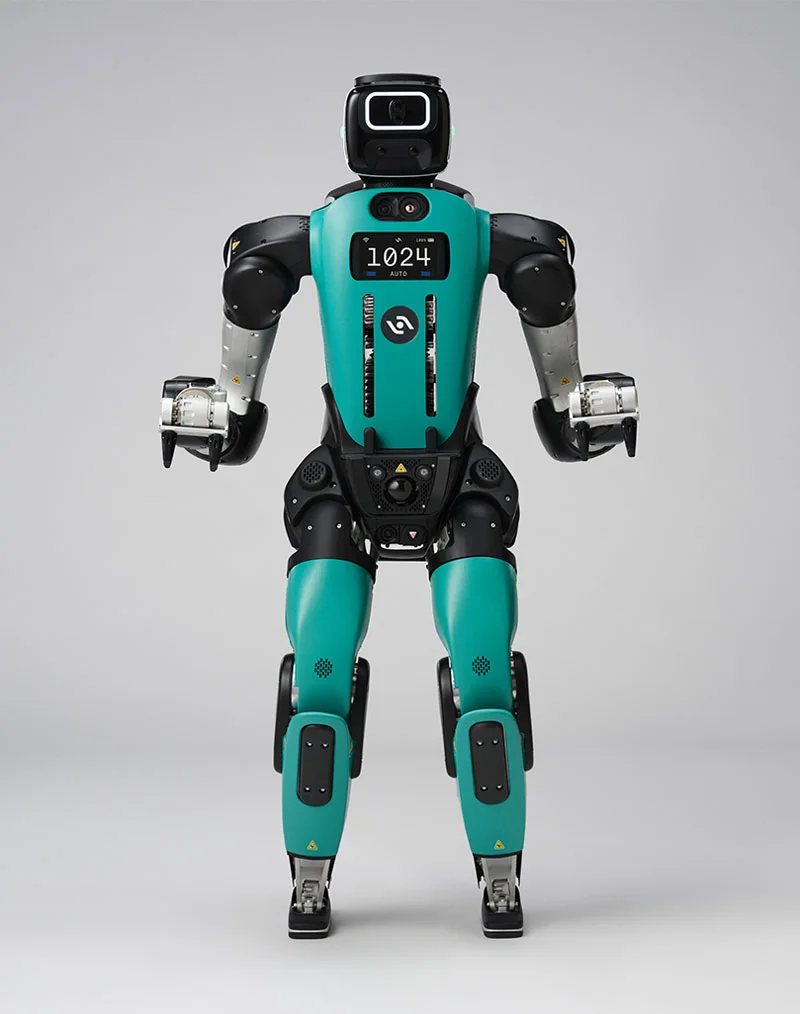
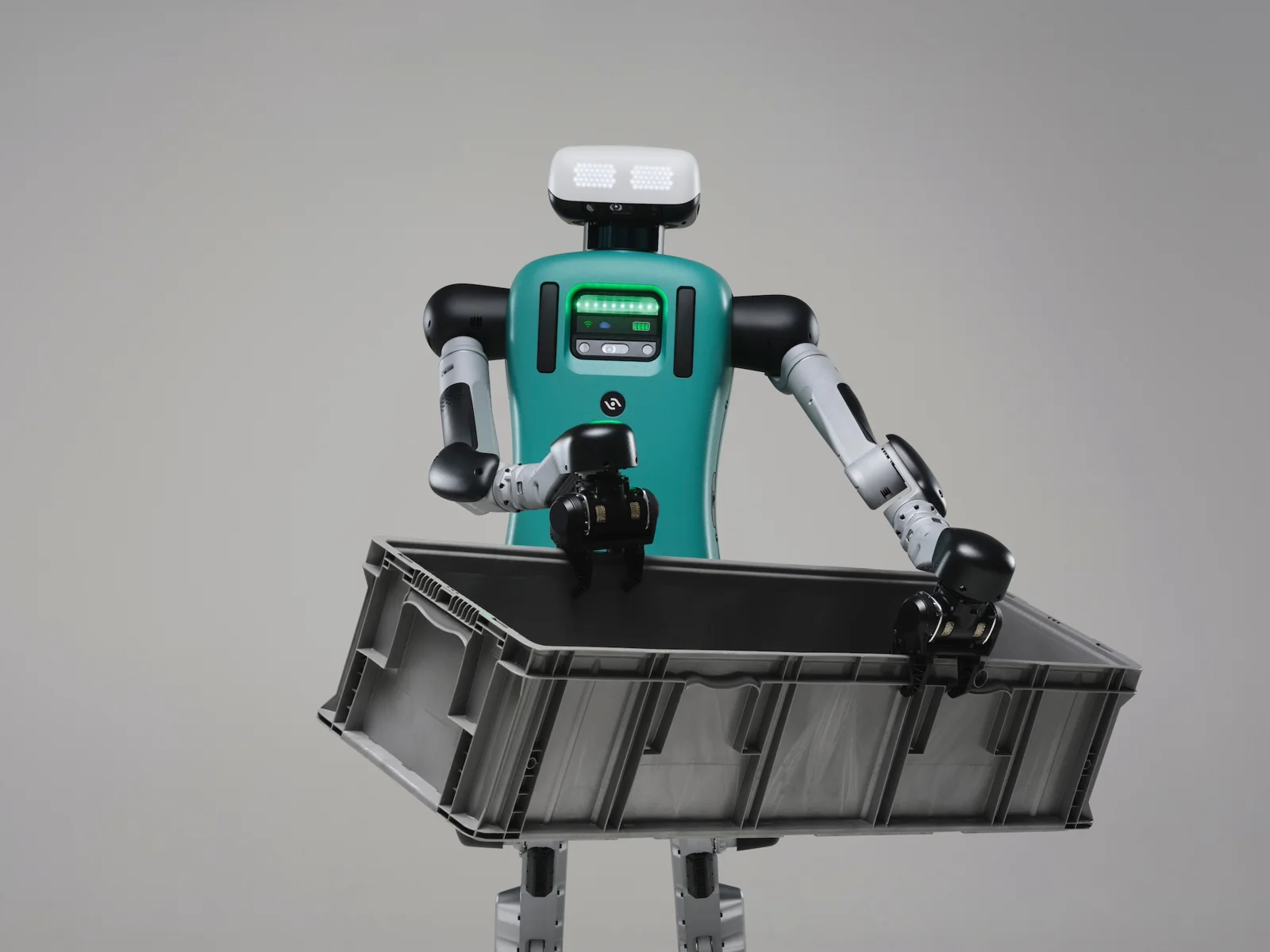
    Agility Robotics Digit humanoid holding a grey tote
    Agility’s Digit humanoid. Photo: Agility Robotics press materials

    SALEM, Ore. — Agility Robotics, the maker of the Digit humanoid robot, said the SEC declared effective on Oct. 13 the Form S-4 registration statement it filed jointly with Churchill Capital Corp XI (Nasdaq: CCXI). That clears the way for a shareholder vote on their merger.

    The deal in numbers
    Nov. 2, 2026 Churchill XI extraordinary general meeting to vote on the merger (record date Sept. 14)
    AGLT Expected Nasdaq ticker after closing; close expected November 2026
    $620M+ Expected gross proceeds, assuming no redemptions
    ~$424M Cash in Churchill XI’s trust account
    ~$200M Common-stock PIPE led by Foxconn
    $300M+ Committed Digit 5 orders, subject to contractual milestones and specs

    What Agility brings to market

    • 65,000+ hours of real-world operation for earlier Digit generations.
    • Up to 10,000 robots a year: the stated design capacity of its RoboFab factory in Salem, Ore.
    • 9 committed customer facility deployments today, with a goal of up to 25 by year-end 2027.
    • Digit 5 early-access availability targeted for early 2027.
    Agility Robotics Digit humanoid robot, front view
    Digit, front view. Photo: Agility Robotics press materials

    Who’s using it

    Named customers include Schaeffler, GXO and Toyota Motor Manufacturing Canada, which signed a Robot-as-a-Service deal after a pilot. Strategic backers listed by the company include DCVC, NVIDIA, SoftBank Vision Fund 2, Schaeffler, Foxconn, Abico and Playground Global.

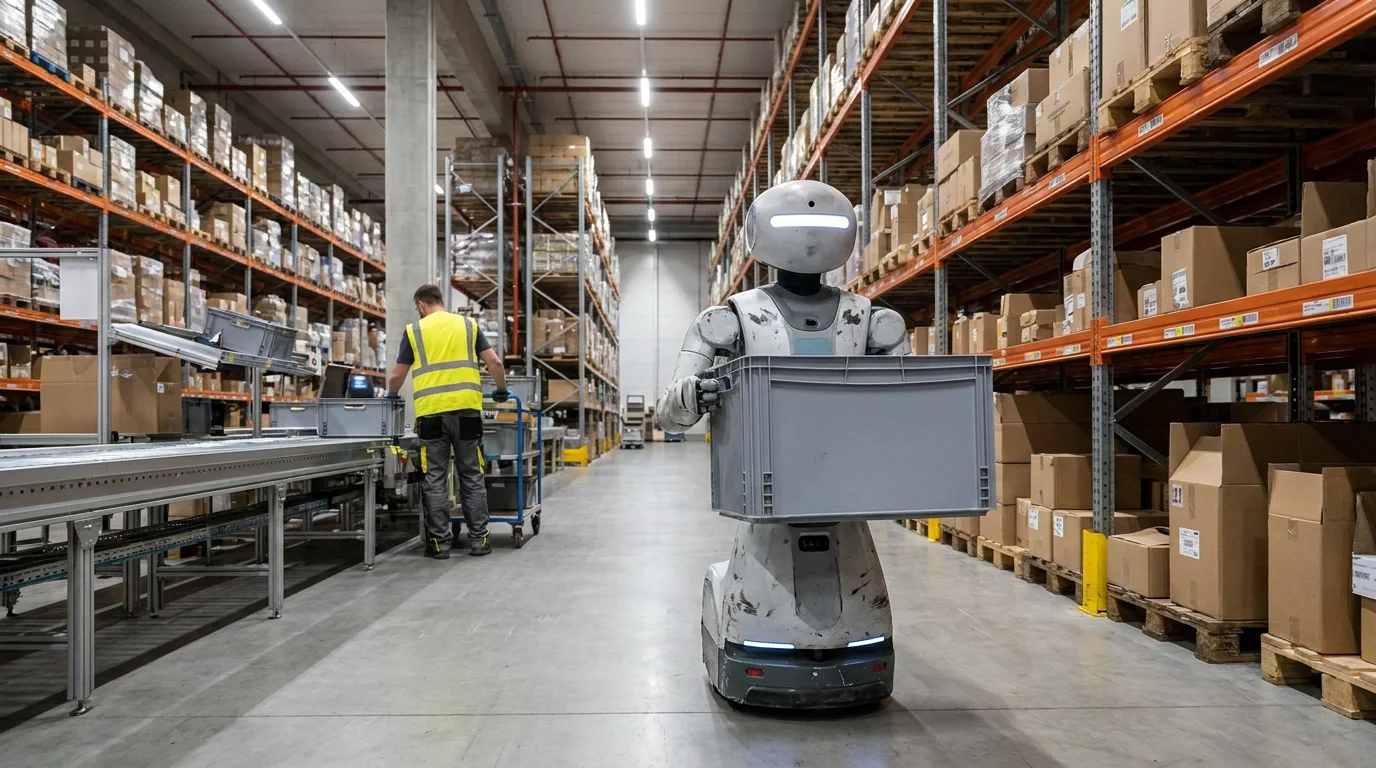
    Illustration of a generic humanoid robot carrying a tote in a warehouse
    Tote-moving in logistics is the classic humanoid job. Illustration: Zip Robotic (generic robot, not Digit)

    Agility says the combined company would be the only U.S.-listed pure-play humanoid company with proven, active commercial deployments. (Company claim.)

    What could still change

    The deal still needs Churchill XI shareholder approval and other customary closing conditions. Shareholder redemptions could reduce the cash raised.

    Agility Robotics logo
    Logo: Agility Robotics press materials

    Source: Agility Robotics press release, Oct. 13, 2026

  • Robotics Recap: Boston Dynamics Names Ex-Amazon AI Chief CEO, RobCo Hits $1B and 2 More

    Robotics Recap: Boston Dynamics Names Ex-Amazon AI Chief CEO, RobCo Hits $1B and 2 More

    Four days, four stories, one theme: money and management are moving toward physical AI faster than the robots themselves. Between Sunday and Wednesday morning, Boston Dynamics handed the top job to an AI executive rather than a roboticist, a Munich-born robot maker crossed a $1 billion valuation, Teradyne bought into the factories that build AI servers, and a new humanoid startup chose a human pilot over full autonomy. Here is what happened and why it matters.

    Boston Dynamics names former Amazon AI chief Rohit Prasad CEO

    Boston Dynamics said on October 6 that Rohit Prasad becomes chief executive on October 7. Prasad spent 12 years at Amazon, most recently as senior vice president and head scientist for Alexa and artificial general intelligence. He helped build Alexa from its earliest days and later led development of Amazon’s Nova foundation-model family. Before Amazon he spent nearly 14 years at Raytheon BBN Technologies running machine-learning research. The company says he is also expected to join its board, subject to approval.

    The announcement leans hard on two words: “Physical AI.” Hyundai Motor Group vice chair Jaehoon Chang, who chairs the Boston Dynamics board, framed the hire as pairing the company’s robots with Prasad’s record of turning AI into products at global scale and Hyundai’s manufacturing muscle. That matters because Hyundai is preparing to put Atlas to work at scale, a programme we covered when the Georgia Atlas training plant opened.

    Why it matters: Boston Dynamics has never lacked for hardware. Hiring a foundation-model builder signals that the board thinks the bottleneck is now software: getting Spot, Stretch and Atlas to do useful work in messy places without a team of engineers behind each deployment.

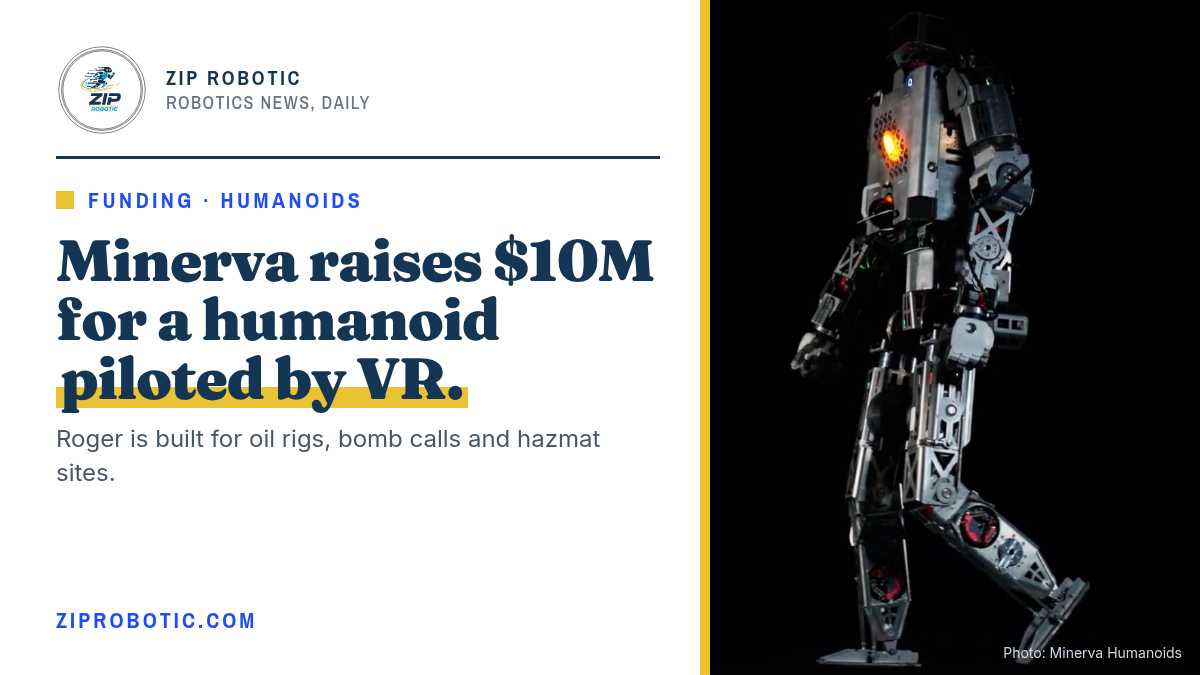
    Minerva Humanoids leaves stealth with $10 million for VR-piloted robots

    Minerva Humanoids, based in San Francisco, announced on October 6 that it has raised about $10 million in pre-seed funding led by General Catalyst, with Long Journey Ventures and Credo Ventures as co-leads. Its robot, Roger, is a semi-autonomous humanoid that a trained specialist operates through a VR headset. The company’s own AI layer, Minerva Intelligence, handles balance, fall recovery and navigation, while the human handles judgment and fine manipulation.

    The target jobs are the ones people least want to do in person: onshore and offshore oil and gas work, explosive ordnance disposal and hazardous-material response. Minerva cites its own estimate, built from ILO and IEA data, that an energy worker dies on the job roughly every 75 minutes worldwide. CEO Sandor Felber previously worked on MIT CSAIL’s humanoid research and Tesla’s Optimus programme; CTO Maurice Rahme spent six years at Boston Dynamics as a technical lead on Stretch. Minerva says it went from idea to a walking humanoid in five months and plans paid pilots this fall.

    Why it matters: Teleoperation sidesteps the hardest problem in humanoids, full autonomy, and sells into markets where a single avoided injury justifies the cost. Minerva has not yet published specifications, latency figures or named customers. Read our full report on Minerva.

    RobCo doubles to a $1 billion valuation in nine months

    RobCo said on October 5 that it has passed a $1 billion valuation, double where it stood nine months ago. The deal was structured largely as an employee secondary sale, letting long-time staff cash out part of their equity, while also bringing new money into the company. Existing investors including Sequoia, Lightspeed, Greenfield, Kindred, Lingotto and Promus Ventures took part, joined by new backers Cherry Ventures and European Tech Collective.

    RobCo, founded in Munich in 2020, delivers end-to-end industrial robotics systems on a robotics-as-a-service model with no upfront cost. The US is now its fastest-growing market, with customers in more than a dozen states, assembly in Austin, Texas, and a lab in San Francisco. Co-founder and CEO Roman Hölzl has moved to the US to lead that push. RobCo will commercially launch Alfie, its autonomous industrial robot, at its first RobCoN summit in Munich on March 4, 2027.

    Why it matters: A secondary-heavy round is a confidence signal more than a war chest. It shows investors are paying up for industrial robotics companies with real factory revenue, not just humanoid demos. For context on how fast factory automation is growing, see our report on five million robots now working in factories.

    Teradyne invests in Bright Machines to automate AI-server production

    Teradyne, the test-equipment giant behind Universal Robots, announced a strategic investment of undisclosed size in Bright Machines on October 5. Bright Machines builds software-defined “microfactories” and says it has deployed more than 130 of them in more than 10 countries for over 60 customers. It already runs AI-infrastructure production in the United States and counts BlackRock, NVIDIA, Microsoft and Eclipse among its backers.

    The two companies say they will explore combining Bright Machines’ manufacturing platform with Universal Robots cobots and Teradyne board-test systems on the same production floor. Connecting assembly, robot and electrical-test data would give customers a single production record running from design to final test. Teradyne chief AI officer James Davidson put the goal plainly: robots that can pick up a new task in hours instead of being re-engineered over weeks.

    Why it matters: The AI hardware boom needs factories that can retool as fast as chip designs change. Teradyne is betting that robotics plus test data is how those lines keep up.

    The takeaway

    Strip away the press-release language and the week has one message: the capital and leadership in robotics are flowing to whoever can make AI work in the physical world. Watch for Prasad’s first product moves at Boston Dynamics, Minerva’s first pilot results, and RobCo’s Alfie launch in March.

    Sources

  • Minerva Humanoids Raises $10 Million for VR-Piloted Robots on Oil Rigs and Bomb Calls

    Minerva Humanoids Raises $10 Million for VR-Piloted Robots on Oil Rigs and Bomb Calls

    Minerva Humanoids emerged from stealth on 6 October with a $10 million pre-seed round led by General Catalyst, co-led by Long Journey Ventures and Credo Ventures. The company is building Roger, a semi-autonomous humanoid that a trained specialist pilots remotely through a VR headset, and it is pointing the machine at four markets where the fatality rate does the selling: onshore and offshore oil and gas, explosive ordnance disposal, hazardous-material response and airport public safety.

    Why it matters: a human in the loop, not a robot on its own

    Almost every well-funded humanoid programme is chasing full autonomy in a warehouse. Minerva is betting the first revenue arrives earlier and from the other direction — keep the human judgment, move the human body out of the blast radius. Roger’s balance, fall recovery and navigation run on Minerva Intelligence, the company’s own software stack; the decisions stay with the operator, who works from an office or from home.

    The founders have the pedigree the pitch needs. CEO Sandor Felber worked on humanoid research at MIT CSAIL and contributed to Tesla’s Optimus programme. CTO Maurice Rahme spent six years at Boston Dynamics as a technical lead on Stretch, the box-moving robot that is arguably the only commercially deployed non-humanoid from that company’s catalogue. Minerva says it took a fully functional prototype from nothing in five months, and plans manufacturing in both Germany and the United States.

    The round itself is small. Figure, 1X and Apptronik are raising at valuations three orders of magnitude above a $10 million pre-seed, and the investor list here — which also includes MVP Ventures, Kaya, RunwayVC, Compound, Founders Embassy, Hugging Face and Codecademy — reads as angel-heavy rather than institutional. What that buys is a prototype and a wedge, not a production line. Minerva has published no specification for Roger: no height, no payload, no teleoperation latency figure, no endurance number, and no named customer or pilot site in any of the four target industries. Those are the numbers that will decide whether an offshore operator lets the thing near a flare stack.

    “People are dying every day doing jobs the rest of the world takes for granted. We set out to build a robot that lets them do the job efficiently from the comfort of their office or home.”

    Sandor Felber, co-founder and CEO, Minerva Humanoids

    Sources

  • Tekever Raises $580 Million at a $6.4 Billion Valuation on 50,000 Drone Flight Hours

    Tekever Raises $580 Million at a $6.4 Billion Valuation on 50,000 Drone Flight Hours

    LONDON — Tekever has closed the first tranche of a Series D round worth $580 million at a $6.4 billion valuation, the uncrewed-systems maker announced on 23 September. The round is co-led by UC Investments, the investment arm of the University of California, and Baillie Gifford, with Merlyn Advisors joining as a new strategic investor alongside existing backers Crescent Cove, Ventura Capital and Iberis Capital.

    By the numbers

    The valuation is a steep mark-up on where the company was trading in August, when Bloomberg reported it was seeking roughly €500 million at a €5.5 billion valuation. Tekever was founded in Portugal in 2001 and has since moved its headquarters to the UK. Its systems have logged more than 50,000 operational flight hours in Ukraine since 2022 — the operational record investors are explicitly pricing.

    The order book behind the raise is concrete. In July the British Army selected Tekever’s AR5 for Project CORVUS, its Watchkeeper replacement, in a contract worth up to £400 million over 10 years, with airframes built in Swindon. The AR5 is a fixed-wing aircraft with 20 hours of endurance, a 100 km/h cruise, a 7.3-metre by 4.0-metre airframe and a 50 kg payload, launched and recovered from unprepared airstrips. Tekever markets it as Europe’s first UAS-based maritime surveillance system; the Portuguese Air Force flies it for exclusive economic zone patrol.

    Tekever says the capital goes to international expansion, manufacturing and technology capacity, and acquisitions. That last item is not idle: on 22 September the company signed a memorandum of understanding with Estonia’s Threod Systems, a day before the raise went public. Neither revenue nor headcount was disclosed.

    “Europe’s security will increasingly depend on its ability to build technology companies that can innovate at speed.”

    Sir Ben Wallace, portfolio manager at Merlyn Advisors and former UK Defence Secretary

    Baillie Gifford investment manager Chris Evdaimon credited Tekever’s “software-centric model and operational experience” with letting it turn technology into deployable capability quickly — the same argument every physical-AI company now makes, with the difference that this one has the flight hours to cite.

    Sources

  • D-Robotics Raises $400 Million With Sunrise Chip Shipments Past 8 Million

    D-Robotics Raises $400 Million With Sunrise Chip Shipments Past 8 Million

    BEIJING — D-Robotics, the robot-computing chip company spun out of Horizon Robotics in 2024, has closed a $400 million Series C — about 2.68 billion yuan — announced on 17 September. The company named only “a leading global internet company” as the lead, alongside institutional investors and existing shareholders. It is the third round D-Robotics has raised this year, after Series B1 and B2, taking its 2026 total to roughly 4.5 billion yuan.

    By the numbers

    Cumulative shipments of the Sunrise chip series passed 8 million units by mid-2026. The flagship part is the Sunrise S600, launched in November 2025 and quoted at 4,800 TOPS with 1/2 sparsity — a figure worth reading carefully, since sparsity-adjusted throughput is not the same as dense compute, and D-Robotics has not published a dense number. The company says the S600 picked up more than 20 customers in its first six months and that first-half revenue grew several-fold year over year.

    The named customer list is a fair map of China’s embodied-AI sector: UBTECH, Fourier, Astribot, X Square Robot, Spirit AI, Booster Robotics, PaXini Tech and TARS. Around that sits a developer ecosystem the company puts at more than 500 robotics companies, 500 universities and 100,000 developers in over 20 countries. D-Robotics claims coverage of more than half the Chinese embodied-intelligence market — a self-reported share with no independent audit behind it.

    The money is earmarked for widening the Sunrise line across compute tiers and for the software stack that sits on top of it — the “brain for every robot” pitch that every silicon vendor in this category now makes, Nvidia included.

    Why it matters

    The July decision by the U.S. Federal Communications Commission to add foreign-made mobile communicating robots over 2 kg to its Covered List bars imports of finished Chinese machines, not the chips inside them. But the practical effect is the same direction of travel: a Chinese robot-silicon supplier scaling on domestic demand, with a customer base that is almost entirely domestic, while U.S. builders consolidate around Nvidia and Qualcomm. Two stacks, diverging — and $400 million buys a lot of divergence.

    Sources

  • RobotPlusPlus Raises Series C After Derusting 10,000 Ships’ Hulls

    RobotPlusPlus Raises Series C After Derusting 10,000 Ships’ Hulls

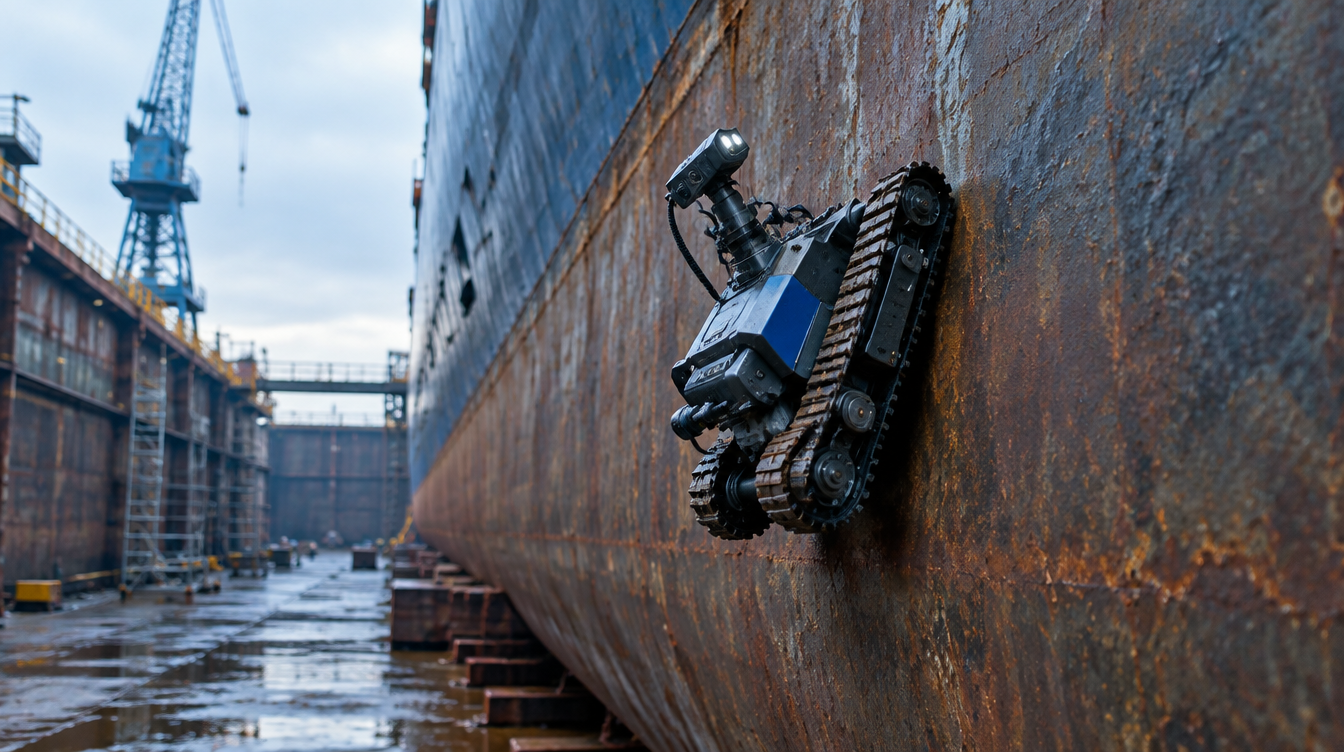
    BEIJING — RobotPlusPlus has closed a Series C round the company describes as worth hundreds of millions of RMB, or tens of millions of US dollars, led by Qianggang Capital Fund. The Beijing company builds special-purpose robots for work at height, and its hull-derusting machines have now stripped and prepped more than 10,000 large cargo vessels across 100-plus shipyards worldwide — a share of that market the company puts above 70%.

    By the numbers

    GIG Capital Group, Sealand Innovation and Juntong Capital joined the round, with existing backer Fosun RZ Capital increasing its stake. The company reports more than 2 million cumulative operating hours across its fleet, 480-plus patents, and over 60% of staff in R&D. It says it is active in 18 countries, naming NOSCO Shipyard in Vietnam, Drydocks World in Dubai, ST Engineering Marine in Singapore, Saudi Aramco and Vopak as customers.

    Hull derusting is one of the ugliest jobs in shipbuilding. Workers on suspended platforms blast rust and old coating off steel, breathing abrasive dust, for weeks per vessel. It is also the kind of job where a robot does not need general intelligence — it needs to stick to a curved steel wall, track its own coverage, and not fall off. That narrowness is why this corner of robotics has commercial scale while humanoids are still shipping in the hundreds.

    The same platform is being pushed into tank surface preparation, wind turbine blade inspection and building facade cleaning — adjacent markets that share the core problem of holding position on a large vertical surface. RobotPlusPlus frames the operating hours as a data asset as much as a revenue line, arguing the fleet is training itself in the field.

    “The true value of industrial robotics lies in real-world execution. Over ten years, we have built special-purpose robots that are genuinely deployable at scale, and this round lets us bring those solutions to more industrial sites around the world.”

    Dr. Hua-Yang Xu, Founder and CEO, RobotPlusPlus

    One caveat worth stating plainly: the company has not disclosed an exact figure, a pre- or post-money valuation, or revenue. The deployment statistics are the company’s own and are not independently audited. What is verifiable is that the round closed and who led it.

    Sources

  • Figure Lines Up 100,000 Nvidia GPUs in $3.5B Nscale Compute Deal

    Figure Lines Up 100,000 Nvidia GPUs in $3.5B Nscale Compute Deal

    Figure has signed a strategic partnership with Nscale for up to 100,000 GPUs on Nvidia’s Vera Rubin platform to train Helix, the AI model that drives its humanoid robots. The initial commitment is $3.5 billion, with stated intent to scale past $6 billion. First deployment is targeted for the second half of 2027 in Barstow, Texas.

    Why a robot company needs a frontier-lab GPU budget

    Figure’s argument is that humanoid intelligence is now a data-and-compute problem, not a hardware problem. The company says its Index dataset is generating 35 minutes of robot data every second from deployed machines, and that training on it at scale is the bottleneck. A 100,000-GPU cluster puts Figure’s compute in the same league as major AI labs.

    Nscale is also making a strategic investment in Figure, and the two companies say they’ll explore putting Figure humanoids to work in Nscale’s own data-center supply chain — the kind of closed-loop deal that has become a pattern in physical AI.

    “The physical AI flywheel that will accelerate the path from models to robots.”

    Jensen Huang, Nvidia CEO, on the partnership

    Sources

  • Unitree Soars Nearly Sixfold in Blockbuster Shanghai IPO Debut

    Unitree Soars Nearly Sixfold in Blockbuster Shanghai IPO Debut

    SHANGHAI — Unitree Robotics, the Hangzhou company whose dancing and backflipping robots have become the public face of Chinese humanoids, listed on Shanghai’s STAR Market today under ticker 688836 — and promptly delivered one of the wildest debuts in the exchange’s history.

    Priced at 150.8 yuan, the stock opened at 1,100 yuan and closed at 883.87 yuan, up roughly 486%. The offering raised about $900 million for a 10% stake. Depending on whose math you use, that values the company somewhere between $50 billion (Reuters) and $66 billion (SCMP and Fortune) — far above any US humanoid rival.

    A real business underneath the hype

    Unlike most robotics IPO candidates, Unitree is profitable. Filings show 2025 revenue of 1.699 billion yuan and net profit of 590 million yuan, with humanoids now making up 51.78% of sales. The company shipped more than 5,500 humanoid units in 2025 — a volume no Western company has publicly come close to.

    The catch

    Three weeks before the listing, the US FCC added foreign-made mobile robots over 2 kg to its Covered List, effectively banning imports of new Unitree models into the United States on national-security grounds. The market clearly didn’t care today. Whether it matters over the next five years is the real question for shareholders.

    Sources

  • Amazon Signs Global Supply Deal With AutoStore for Warehouse Automation

    Amazon Signs Global Supply Deal With AutoStore for Warehouse Automation

    OSLO — AutoStore, the Norwegian company that invented cube-storage automation, has announced a global strategic supply agreement with Amazon. The deal establishes a framework under which AutoStore can supply its automated storage and retrieval systems to Amazon across all regions.

    Read the fine print

    The announcement was filed as inside information under EU market-abuse rules, and it is careful to say there are no binding purchase commitments yet. In other words: Amazon has agreed on terms to buy, not agreed to buy. That’s still meaningful — Amazon builds most of its warehouse robotics in-house and rarely signs framework deals with outside automation vendors.

    The news landed alongside AutoStore’s second-quarter results, which showed record revenue and a new $75 million share buyback.

    Why it matters

    Cube storage — dense grids of bins with robots running across the top — is the highest-density warehouse automation format available. If Amazon standardizes on it for even a slice of its network, it validates the format for every mid-size retailer that has been waiting to see what the biggest logistics operator on earth does.

    Sources