By Zip Robotic · October 18, 2026
Four stories from October 14–17, one theme: uncrewed at sea, faster on land. Sweden got a large robot submarine from contract to sea trials in under a year. Fugro lined up €150 million to put up to 25 more remotely operated survey boats on the water. Boston Dynamics put a number on how long it takes to build an Atlas. And a construction startup came out of stealth with a robot that finishes walls on live job sites.
1. Saab launches a large robot sub in under a year
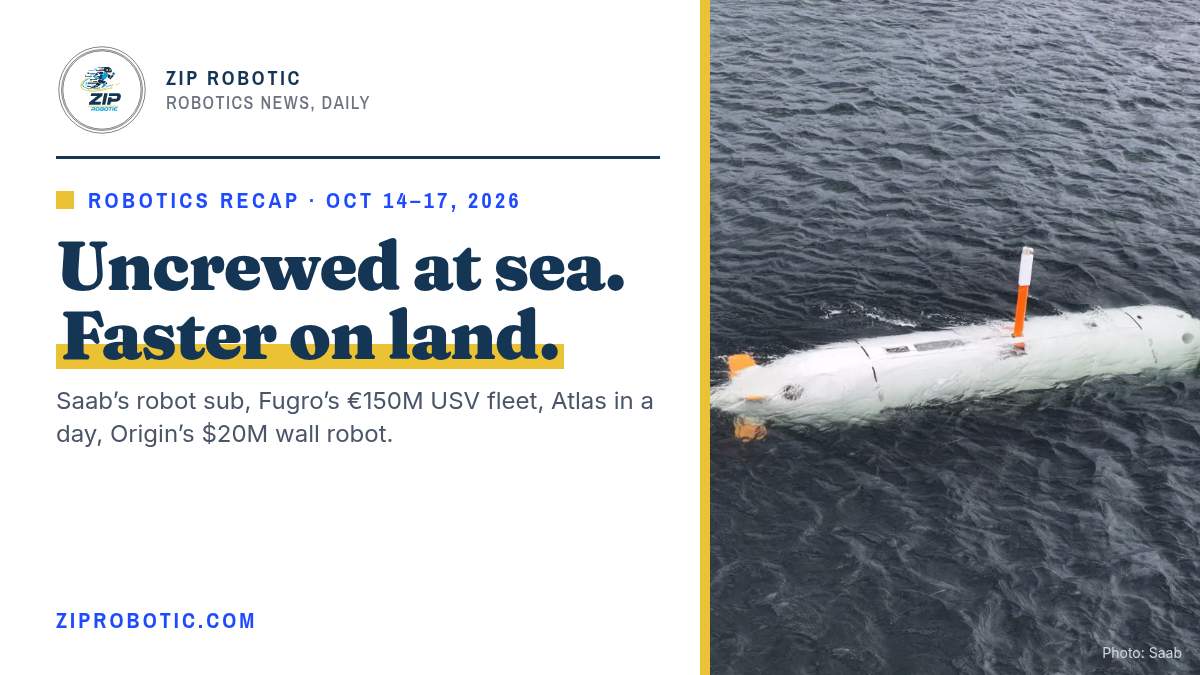
Saab, the Swedish Defence Materiel Administration (FMV) and the Swedish Armed Forces have developed, built and launched a demonstrator for a Large Uncrewed Underwater Vehicle (LUUV) less than one year after contract award, Saab said on October 16. Following successful sea trials, the first phase of the project is complete; the next phase is expected to focus on more advanced capabilities.
Saab credits the pace to its software-centric approach and to Autonomous Ocean Core, its autonomous control system for surface and subsurface vehicles, combined with Swedish submarine design and sensor-integration expertise. The demonstrator is meant to support evaluation of future underwater capabilities and to operate alongside existing naval platforms such as submarines. FMV now leads the project with the Armed Forces and Saab, and the results will feed Swedish decisions on whether and how to buy autonomous underwater systems.
“The fact that we have also been able to develop and test the system in such a short timeframe demonstrates the strength of the collaboration between the Swedish Armed Forces, FMV and Saab,” said Mats Wicksell, head of Saab’s business area Naval.
Why it matters: Navies have spent years talking about large uncrewed subs. Contract to sea trials in under twelve months is a software-speed timeline for a hardware program, and it comes the same week the U.S. Navy deployed the Seahawk USV with a carrier strike group.
Source: Saab press release, Oct 16, 2026
2. Fugro gets €150 million for up to 25 robot survey boats
The European Investment Bank has signed a €150 million unsecured financing facility with Fugro, the Dutch geo-data company that surveys the seabed for offshore wind farms, subsea cables and other marine infrastructure, the two announced on October 14. The money supports the development and deployment of Fugro’s uncrewed surface vessel (USV) technology and the phased expansion of its remote operations.
According to the EIB, the financing enables the deployment of up to 25 new medium-sized, long-range, remotely operated USVs for seabed surveys, site assessments and offshore asset monitoring, plus research into remote sensing and underwater robotics. Paired with underwater robots, the boats let Fugro send subsea data to remote operating centres in real time. The EIB says Fugro’s USVs cut fuel consumption by up to 90% compared with traditional survey vessels. Eligible costs run from January 2025 through December 2031, with drawings of up to 10 years.
“Uncrewed surface vessels and remote operations are an important part of our long-term strategy – enhancing safety, reducing carbon emissions and improving operational efficiency,” said Fugro CEO Mark Heine.
Why it matters: “Up to 25” is a programme ceiling, not a purchase order, but it is a public development bank underwriting a commercial robot fleet. Offshore wind and cable work runs on survey data, and this is a bet that most of it will be collected without a crew aboard. It’s the same direction as Ørsted’s cargo-drone trial at Hornsea 2.
Sources: Fugro press release, Oct 14, 2026 · EIB press release, Oct 14, 2026
3. Boston Dynamics says an Atlas now takes about a day to build
In a roughly six-minute video published October 14, Machine, Assemble, Repair: How We Build Atlas, Boston Dynamics walks through the prototype operations floor where it machines, assembles and repairs its humanoid. Senior Technical Program Manager Katie Conner says building a robot now takes about a day, with an ambition of roughly an hour next year and minutes after that.
Machinists in the video explain why precision work, including gear cutting, stays in-house: engineers can walk down to the shop, change a design and have revised parts the same day or the next. Staff describe robotic arms built into assembly and a loop that can take an idea from Monday to implementation by the end of the week. Boston Dynamics frames the goal as “manufacturing velocity.”
Why it matters: The humanoid race is now a manufacturing race. Note what the number measures: the time to build one robot on a prototype floor, not a production line’s output rate, and the hour is a target, not a result. Context: Boston Dynamics named a new CEO earlier this month and is preparing Atlas for Hyundai’s plants.
Source: Boston Dynamics on YouTube, Oct 14, 2026
4. Origin raises $20 million for a robot that finishes walls
San Francisco-based Origin came out of stealth on October 15 with $20 million in total funding co-led by Accel and Zacua Ventures, with angel investors from Anduril, Skild AI, 1X and Tesla. Its flagship robot, OG-1, autonomously handles wall finishing on live job sites: it applies compound, sands and primes, works at heights of up to 14 feet and uses real-time force control to keep even pressure on the wall. It runs on what Origin calls a Construction Action Model, trained in simulation and on deployment data.
The money goes toward building out the OG-1 fleet and pilots, including with two of the largest drywall finishing contractors in the U.S., with more scheduled in Germany, Sweden, France and Saudi Arabia. Origin is targeting 150 robots deployed by the end of 2027 and says its robots already work at three times human speed. That’s the company’s claim, not an independent measurement.
Why it matters: Origin says interior work makes up more than 65% of construction timelines and is still done mostly by hand. Mechanization so far has focused on heavy exterior work, so a robot that finishes walls next to working crews is aimed at the bigger share of the labor gap.
Source: Origin press release, Oct 15, 2026
The pattern
Below the surface, on the build floor, on the job site. Two marine fleets got real money or real sea time, and two land robots got judged on throughput: how fast you can build one, and how fast it can do a trade. Which move matters most? Tell us on X @ZipRobotic.
Roundups every Wednesday and Sunday at ziprobotic.com.
Sources
- Saab, “Saab, FMV and the Swedish Armed Forces launch uncrewed underwater vehicle,” Oct 16, 2026 — https://www.saab.com/newsroom/press-releases/2026/saab-fmv-and-the-swedish-armed-forces-launch-uncrewed-underwater-vehicle
- Fugro, “Fugro secures long-term funding with new facility from the European Investment Bank…,” Oct 14, 2026 — https://www.fugro.com/news/press-releases/2026/fugro-secures-long-term-funding-with-new-facility-from-the-european-investment-bank-and-two-year-extension-of-existing-senior-debt-facilities
- European Investment Bank, “EIB boosts sustainable development of geo-data experts Fugro,” Oct 14, 2026 — https://www.eib.org/en/press/all/2026-335-eib-boosts-sustainable-development-of-geo-data-experts-fugro
- Boston Dynamics, “Machine, Assemble, Repair: How We Build Atlas,” YouTube, Oct 14, 2026 — https://www.youtube.com/watch?v=dP_i7hRvGpE
- Origin, “Origin Emerges From Stealth With $20 Million to Build General-Purpose Robots for Construction,” Oct 15, 2026 — https://origin.tech/blog/origin-emerges-from-stealth-with-20-million
Images: Saab (LUUV), Fugro (USV), Boston Dynamics (video still), Origin (founders). Used from each company’s own press materials.