Category: Industrial & Logistics

This is robotics that already works and already earns. Industrial arms, mobile robots, warehouse automation, palletising, picking, inspection and the unglamorous machines doing specialised jobs at scale — hull derusting, weld inspection, work at height. The industrial and logistics segment does not generate the headlines that humanoids do, but it is where most robots are deployed, most revenue is booked, and most of the hard-won knowledge about reliability, maintenance and payback period actually lives. We cover new systems and their specifications, deployment numbers in real facilities, integration with existing lines, and the operational realities: uptime, cycle time, service intervals, and what it costs to keep a fleet running. When a humanoid programme eventually has to prove itself on throughput, this is the benchmark it will be measured against.

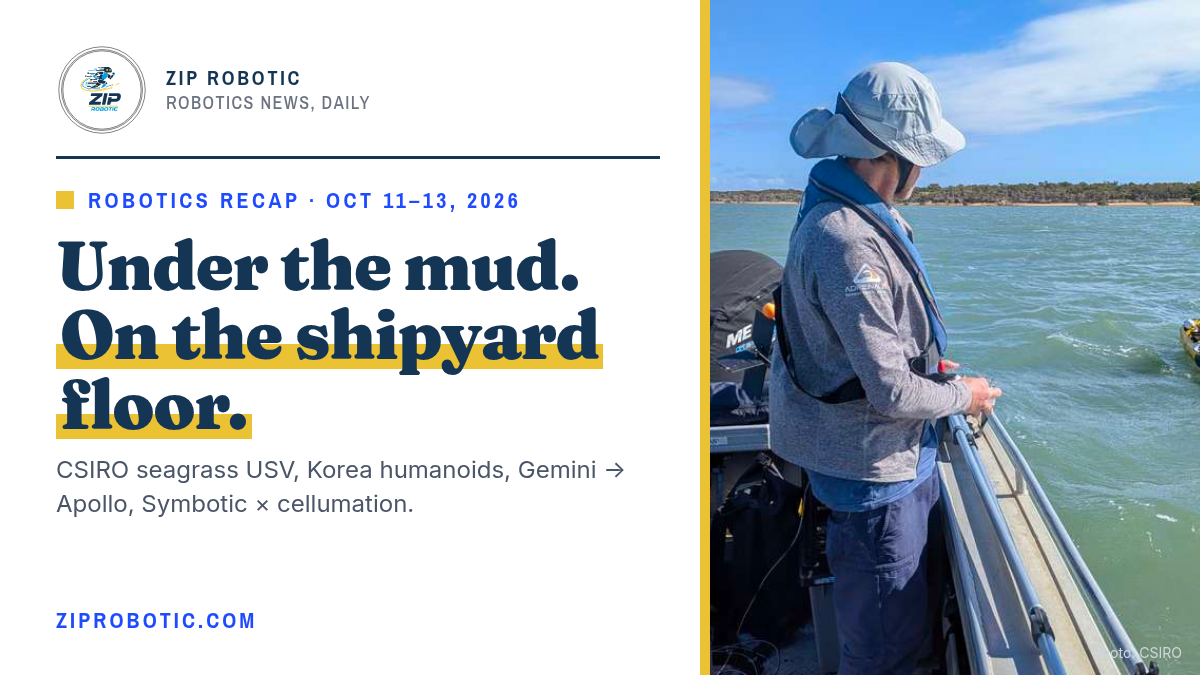
  • Robotics Recap: CSIRO Seagrass USV, Korea Clears Humanoids, Gemini Teaches Apollo and Symbotic Buys cellumation

    Robotics Recap: CSIRO Seagrass USV, Korea Clears Humanoids, Gemini Teaches Apollo and Symbotic Buys cellumation

    By Zip Robotic · October 14, 2026

    Four stories from October 11–13, one theme: robots under murky water, on shipyard floors, learning from video, and buying European sortation. CSIRO and partners are towing a camera vehicle behind an uncrewed boat to map seagrass where divers and clear water fail. South Korea cleared 20 Robros bipedal humanoids for live factory tests beside workers, including a Hyundai shipyard. Google DeepMind’s Gemini 4 Argon watched a human play cornhole, wrote its own sim, and put seven straight shots on Apptronik’s Apollo. And Symbotic bought Bremen’s cellumation for the celluveyor sortation deck. Here is what happened and why it matters.

    CSIRO tows a camera under murky water for seagrass

    CSIRO published a partner release on October 13 on trials of a towed underwater vehicle with CQUniversity’s Coastal Marine Ecosystems Research Centre and the Great Barrier Reef Foundation. The tethered system is built to collect high-definition imagery and environmental data just above the seabed in turbid coastal water, where traditional survey methods struggle.

    CSIRO Principal Research Engineer Dr Torsten Merz describes a robotic pair: an uncrewed surface vessel and a towed underwater vehicle. Images are recorded and processed on board the USV and sent to users by radio link; AI-generated analysis is meant to speed seagrass monitoring and assessment. CMERC Director Professor Emma Jackson said researchers can position the camera just above the seabed and tow it over long distances while collecting georeferenced imagery and data. Field work includes Gladstone deployments. In intertidal areas, the TUV can be paired with aerial drone surveys for ground-truthing without walking long distances across sensitive habitat. A final project report is expected later this year. Scaling SeaGrow funding comes from the Australian Government’s Reef Trust and the Great Barrier Reef Foundation.

    Why it matters: Marine science still loses coverage in brown water. A USV that tows eyes along the seabed is a practical autonomy story—restoration and carbon-storing meadows, not just warships.

    Korea clears 20 Robros humanoids for factory floors next to people

    Seoul Economic Daily reported on October 13 that South Korea’s Ministry of Trade, Industry and Energy granted a regulatory sandbox testing exemption to Robros after the sixth Industrial Convergence Regulatory Sandbox Review Committee meeting of 2026. Twenty AI-equipped bipedal humanoids will work at Nepes, Sungwoo Hitech, HD Hyundai Samho and Delivery Lab, in spaces shared with or adjacent to human workers.

    Task mix: cleaning contaminants from circular semiconductor packaging components at Nepes; positioning auto body parts at Sungwoo Hitech; stacking scaffolding brackets that secure elevated work platforms to a ship’s hull at HD Hyundai Samho; moving refrigerated logistics packaging at Delivery Lab. Safety rules written for fenced, stationary industrial robots did not fit mobile humanoids. The government approved the test on the condition that Employment and Labor risk assessments and risk-reduction measures are carried out; the data is meant to inform new safety standards for wider industrial adoption. Trade Minister Kim Jung-kwan said regulation struggles to keep up with AI and that institutional bottlenecks need to come down fast.

    Why it matters: This is a live regulatory path for humanoids sharing floors with people—and one of the four sites is a shipyard stacking hull scaffolding. That is manufacturing autonomy with a marine-adjacent footprint.

    Gemini 4 Argon teaches Apollo cornhole from one video

    Google launched Gemini 4 Argon on October 13. In the same post, Google says Argon scores 87% on the Embodied Reasoning (ERQA) benchmark using pure reasoning. To show robotics skill transfer, Google describes an internal test: Argon watched a raw video of a human playing cornhole, mapped the environment’s spatial coordinates, calculated the whole-body joint movements required, autonomously built the simulation code, and transferred the behavior to Apptronik’s Apollo humanoid. In a real-world trial, Apollo sank seven consecutive shots. Google calls the pipeline “Video-to-Sim-to-Real” and says it can compress weeks of manual simulation modeling into a few hours. A companion Google Developers Blog post the same day walks through Argon workflows across robot control, Real2Sim, physical understanding and self-improvement.

    Why it matters: If ordinary video becomes a training ground because the model writes the sim itself, the long tail of robot skills stops needing a hand-built world for every new task.

    Symbotic buys cellumation and the celluveyor

    Symbotic Inc. announced on October 13 that it has acquired cellumation GmbH of Bremen, Germany, creator of the celluveyor—a patented, software-driven sortation platform. The celluveyor is made of hundreds of independently controlled omnidirectional cells; each cell can move an item in any direction, so the surface decides where products should go while moving them. Symbotic says the tech can deliver more throughput and handle a wider product mix in a fraction of the space traditional conveyors need, and that it is a key enabler for denser inbound and outbound robotic cells.

    cellumation will keep its name and Bremen headquarters, serving its existing global customers while Symbotic accelerates European expansion. Co-founders Dr.-Ing. Hendrik Thamer (CEO) and Dr.-Ing. Claudio Uriarte (CTO) remain with the company. Symbotic Chairman and CEO Rick Cohen tied the deal to prior acquisitions of ARMS Innovations and Fox Robotics and said celluveyor will be sold both as a standalone product and integrated into Symbotic systems. Financial terms were not disclosed.

    Why it matters: A major U.S. warehouse robotics public company is buying European omnidirectional sortation hardware—and keeping the Bremen team as a product company, not just an IP tuck-in.

    The takeaway

    Strip the press language and the stretch says this: under turbid water, a USV+TUV stack is trying to see seagrass at scale; on Korean factory and shipyard floors, regulators just opened a shared-space humanoid trial; in the lab, a frontier model wrote its own sim from a backyard game video and put shots on a humanoid; in the warehouse, Symbotic paid for a denser sortation deck out of Bremen. Watch for CSIRO’s year-end TUV performance report, how Korea’s sandbox data rewrites robot safety rules, whether Video-to-Sim-to-Real shows up outside demo sports, and how fast celluveyor lands inside Symbotic cells versus staying a standalone European product.

    Sources

  • Five Million Robots Now Work in Factories as China Installs 354,000 in a Year

    Five Million Robots Now Work in Factories as China Installs 354,000 in a Year

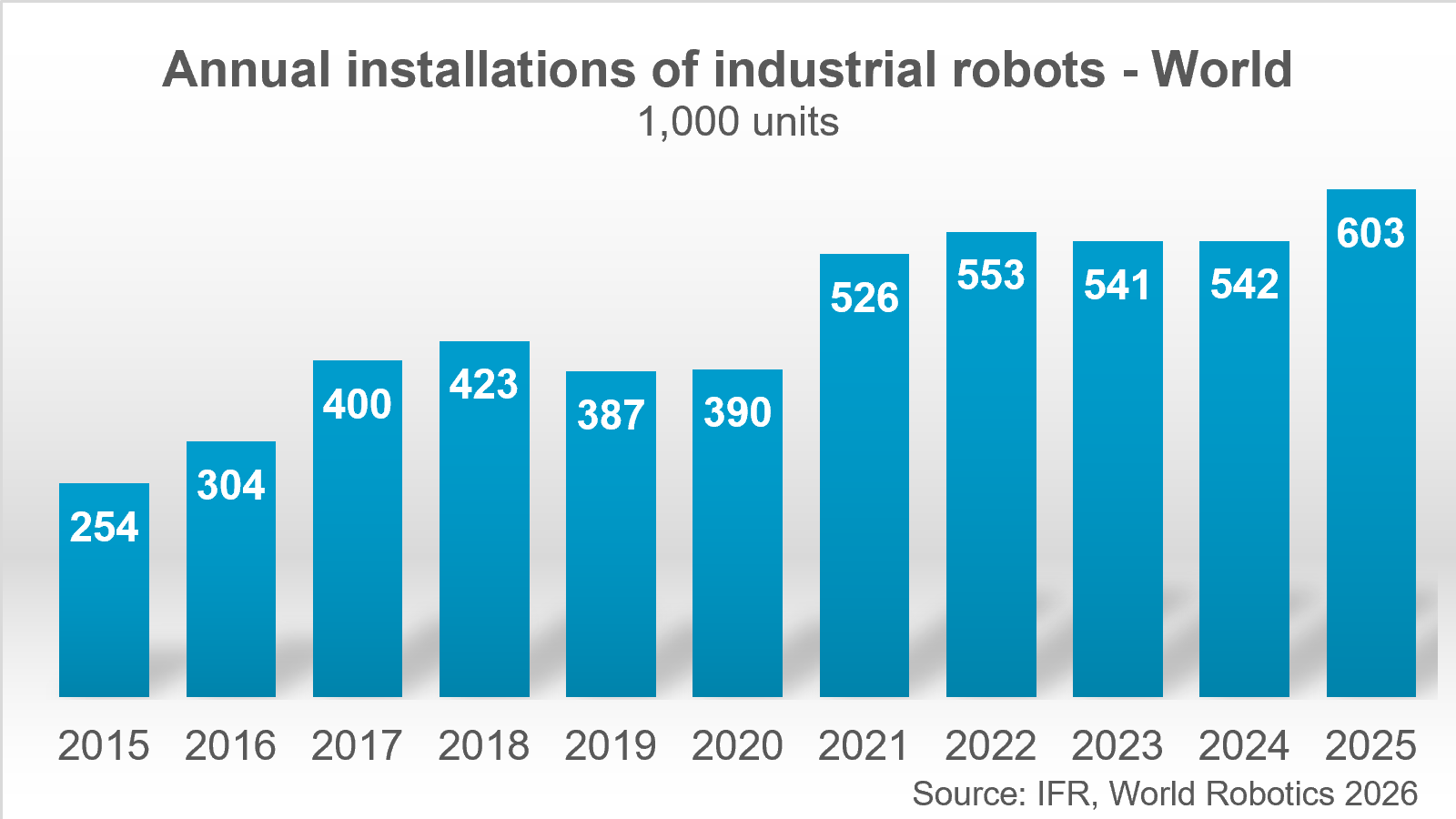
    FRANKFURT — The world’s factories now operate 5 million industrial robots, a 9% increase over the previous year, according to the World Robotics 2026 report published on 24 September by the International Federation of Robotics. New installations passed 600,000 units in 2025, up 11%, and China accounted for 354,000 of them — a 20% rise that gives a single country 59% of global deployments.

    By the numbers

    The distance between China and everyone else is now the dominant fact in the dataset. The United States installed 38,500 robots, up 12%; Japan 36,219, down 19%; South Korea roughly 30,000, down 1%; Germany about 25,000, down 8%. China installed more than nine times as many units as the United States, and more than the rest of the world combined.

    Europe is the weakest region in the report. Germany accounts for 41% of EU installations but shrank; Italy fell 11% to 7,800 units, France 8% to 4,500, Spain 15% to 4,300. The growth outside Asia is in the second tier of manufacturing economies — India added 10,500 robots, up 15%, and Brazil 4,300, up 38%, the fastest percentage gain among the countries IFR breaks out.

    IFR expects 655,000 installations in 2026, another 9% increase, and 806,000 a year by 2029. That forecast matters for the humanoid and physical-AI companies now raising money against factory demand: the 5 million installed base they are pitching against is a stock of conventional arms and cells, and it is still growing at roughly 600,000 a year without them.

    “Industrial automation is progressing at high speed. The new mark of five million robots operational in factories worldwide is more than double the number seven years ago.”

    Jane Heffner, President, International Federation of Robotics

    Sources

  • UBTECH’s Liuzhou Plant Builds a Humanoid Every 10 Minutes at 10,000-Unit Capacity

    UBTECH’s Liuzhou Plant Builds a Humanoid Every 10 Minutes at 10,000-Unit Capacity

    LIUZHOU, China — UBTECH has begun production at its Liuzhou “super smart factory,” a 14,000-square-metre plant in Guangxi that the company says will roll out one industrial humanoid every 10 minutes at a planned annual capacity of more than 10,000 units. Production started on 12 September and the line builds UBTECH’s Walker S and Cruzr series on a single mixed-model system. Shares in the Hong Kong-listed company (09880.HK) rose more than 3% on 14 September, touching HK$80.4 intraday.

    Why a takt time matters more than a demo

    Humanoid companies have spent three years competing on video. A takt time is a different kind of claim: it is the interval at which a finished unit leaves the line, and it only exists once the process is stable enough to repeat. Ten minutes per unit implies roughly 52,000 units a year at continuous three-shift operation, so the 10,000-unit figure is a capacity target with substantial headroom rather than a theoretical maximum — which is the more credible way to state it.

    The plant is also a showcase for its own product. Walker S units handle depalletizing, palletizing and material loading; collaborative arms on 360-degree rotating stations drive the more than 2,000 screws that go into each robot; AGVs and unmanned forklifts move material; and a fully automated three-dimensional warehouse packs 112 storage robots into 65 square metres, which UBTECH says lifts space utilisation by over 50% against a conventional layout. Each unit carries a serial number tying it to component sourcing, assembly parameters and inspection records, and gets more than four hours of full-unit testing.

    Siemens Digital Industries Software supplied the digital backbone — a 1:1 Plant Simulation model of the factory, and UBTECH’s Yanshee manufacturing operations management system built on Siemens’ Intelligence Center X platform. That is the tell that this is meant to be an automotive-style process rather than a workshop: traceability, digital twin, mixed-line flexibility.

    What UBTECH has not published is a firm order book behind the capacity. Capacity is not demand, and the gap between a line that can build 10,000 humanoids and a market that will buy them remains the open question for the sector. No delivery guidance for 2026 accompanied the commissioning.

    Sources

  • Amazon Signs Global Supply Deal With AutoStore for Warehouse Automation

    Amazon Signs Global Supply Deal With AutoStore for Warehouse Automation

    OSLO — AutoStore, the Norwegian company that invented cube-storage automation, has announced a global strategic supply agreement with Amazon. The deal establishes a framework under which AutoStore can supply its automated storage and retrieval systems to Amazon across all regions.

    Read the fine print

    The announcement was filed as inside information under EU market-abuse rules, and it is careful to say there are no binding purchase commitments yet. In other words: Amazon has agreed on terms to buy, not agreed to buy. That’s still meaningful — Amazon builds most of its warehouse robotics in-house and rarely signs framework deals with outside automation vendors.

    The news landed alongside AutoStore’s second-quarter results, which showed record revenue and a new $75 million share buyback.

    Why it matters

    Cube storage — dense grids of bins with robots running across the top — is the highest-density warehouse automation format available. If Amazon standardizes on it for even a slice of its network, it validates the format for every mid-size retailer that has been waiting to see what the biggest logistics operator on earth does.

    Sources

  • FedEx Scales Dexterity’s Robot Trailer Loaders at Hagerstown Hub

    FedEx Scales Dexterity’s Robot Trailer Loaders at Hagerstown Hub

    HAGERSTOWN, Md. — FedEx has expanded its deployment of Dexterity’s physical-AI truck-loading robots at its Hagerstown, Maryland hub, moving the program past the pilot stage. The systems autonomously stack mixed parcels of different sizes and weights inside trailers — one of the most labor-intensive and injury-prone jobs in the network.

    Why trailer loading is the hard problem

    Picking a single item from a bin is a solved problem. Building a stable wall of random boxes inside a moving-target trailer, without crushing the light ones or wasting cube, is not — it requires the robot to reason about weight, fragility, stability and space in real time. FedEx loads tens of thousands of trailers a day across its network, so even modest automation here is a big number.

    “An important milestone in demonstrating how physical AI can operate reliably in a high-volume logistics environment.”

    Samir Menon, CEO, Dexterity

    Dexterity’s approach — a two-armed robot on a mobile base running a physical-AI stack — is one of several competing for this job; Boston Dynamics’ Stretch and Pickle Robot are chasing the unloading side of the same dock.

    Sources