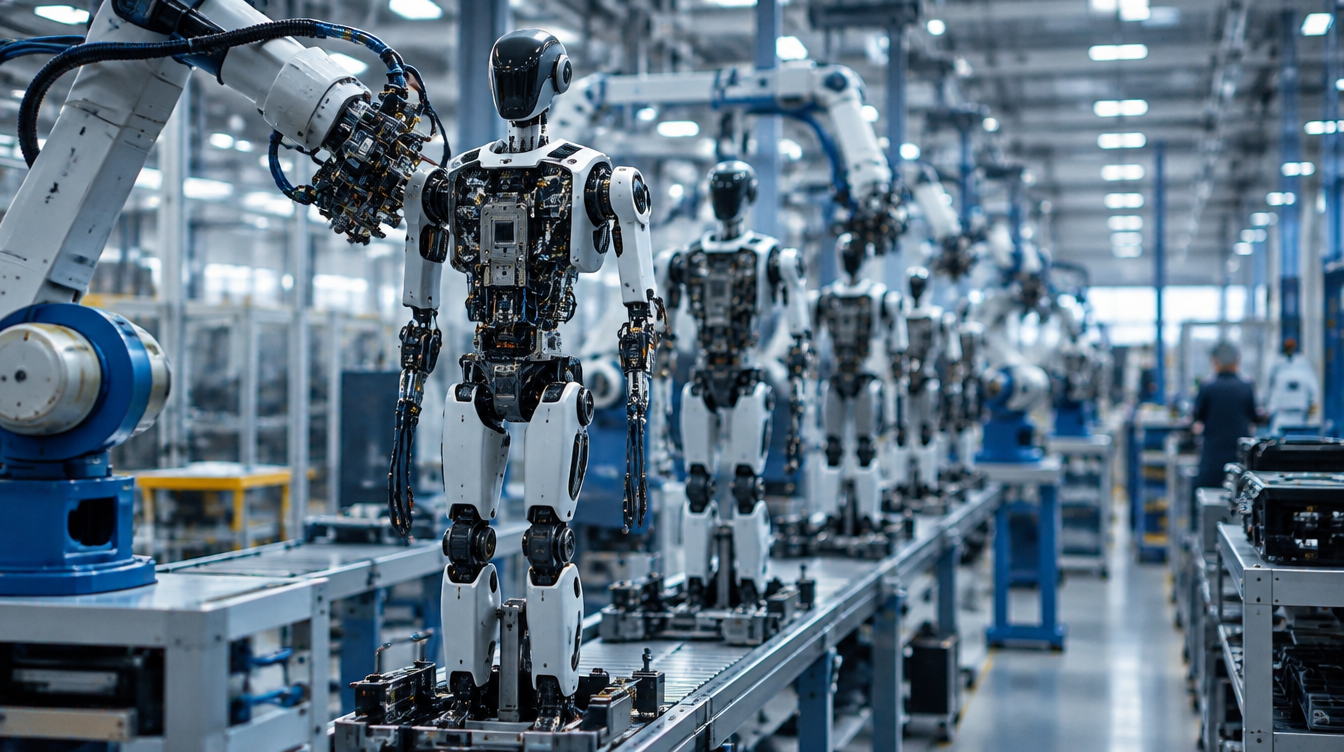
LIUZHOU, China — UBTECH has begun production at its Liuzhou “super smart factory,” a 14,000-square-metre plant in Guangxi that the company says will roll out one industrial humanoid every 10 minutes at a planned annual capacity of more than 10,000 units. Production started on 12 September and the line builds UBTECH’s Walker S and Cruzr series on a single mixed-model system. Shares in the Hong Kong-listed company (09880.HK) rose more than 3% on 14 September, touching HK$80.4 intraday.
Why a takt time matters more than a demo
Humanoid companies have spent three years competing on video. A takt time is a different kind of claim: it is the interval at which a finished unit leaves the line, and it only exists once the process is stable enough to repeat. Ten minutes per unit implies roughly 52,000 units a year at continuous three-shift operation, so the 10,000-unit figure is a capacity target with substantial headroom rather than a theoretical maximum — which is the more credible way to state it.
The plant is also a showcase for its own product. Walker S units handle depalletizing, palletizing and material loading; collaborative arms on 360-degree rotating stations drive the more than 2,000 screws that go into each robot; AGVs and unmanned forklifts move material; and a fully automated three-dimensional warehouse packs 112 storage robots into 65 square metres, which UBTECH says lifts space utilisation by over 50% against a conventional layout. Each unit carries a serial number tying it to component sourcing, assembly parameters and inspection records, and gets more than four hours of full-unit testing.
Siemens Digital Industries Software supplied the digital backbone — a 1:1 Plant Simulation model of the factory, and UBTECH’s Yanshee manufacturing operations management system built on Siemens’ Intelligence Center X platform. That is the tell that this is meant to be an automotive-style process rather than a workshop: traceability, digital twin, mixed-line flexibility.
What UBTECH has not published is a firm order book behind the capacity. Capacity is not demand, and the gap between a line that can build 10,000 humanoids and a market that will buy them remains the open question for the sector. No delivery guidance for 2026 accompanied the commissioning.
Leave a Reply