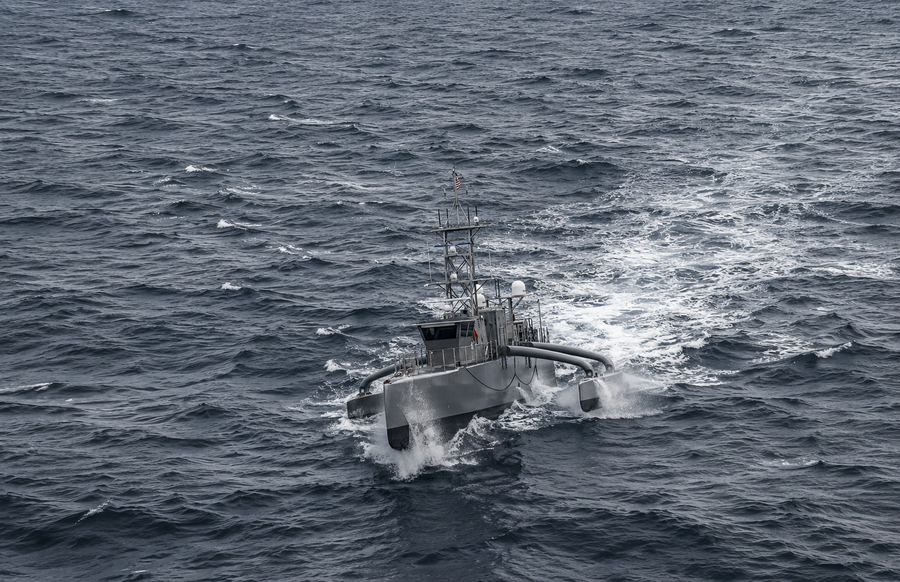
WASHINGTON — The USS Theodore Roosevelt Carrier Strike Group sailed from San Diego in late September with an uncrewed warship in company, the first time a U.S. carrier strike group has deployed with a large autonomous surface vessel. Acting Navy Secretary Hung Cao disclosed the milestone on 14 October at the Association of the United States Army’s annual meeting in Washington. The vessel is Seahawk, a Leidos-built medium unmanned surface vessel that has contributed to a fleet-wide total of more than 200,000 nautical miles of autonomous operation.
By the numbers
Leidos first confirmed the deployment in an 8 September release, which put its cumulative maritime autonomy record at over 200,000 nautical miles and 14,000 hours of safe autonomous operation across more than a decade of development. Seahawk runs the Leidos Autonomous Vessel Architecture (LAVA), a modular stack handling navigation, mission execution and obstacle avoidance.
What the company says Seahawk has demonstrated is specific: autonomous navigation and perception with limited human intervention; collision avoidance compliant with COLREGs, the international rules of the road at sea; automatic routing around designated keep-out zones; retention of control over an alternate communications path when the primary link drops; and waypoint navigation in a GPS-denied environment, with the vessel reacquiring GPS without leaving its track. It operates inside the strike group’s own communications and command-and-control framework rather than on a separate network.
The same release described a second Leidos vessel, Sea Hunter, as the only medium USV at RIMPAC 2026, where it ran autonomously for more than 2,000 nautical miles from Pearl Harbor to San Diego. Published program data put Seahawk at roughly 145 long tons fully loaded with 14,000 gallons of fuel, built under a 2017 Office of Naval Research contract of about $35.5 million and delivered to the Navy in 2021 — figures that do not appear in the Leidos release itself.
The significance is less the hull than the escort slot. A carrier strike group is the Navy’s most tightly choreographed formation; putting an uncrewed ship inside it means the autonomy stack has to satisfy the same station-keeping, deconfliction and communications discipline as a crewed escort, on a real operational deployment rather than in an exercise.
“This is the first carrier strike group to ever deploy with a large-size unmanned surface vessel.”
Hung Cao, Acting Secretary of the Navy, 14 October 2026
Leave a Reply