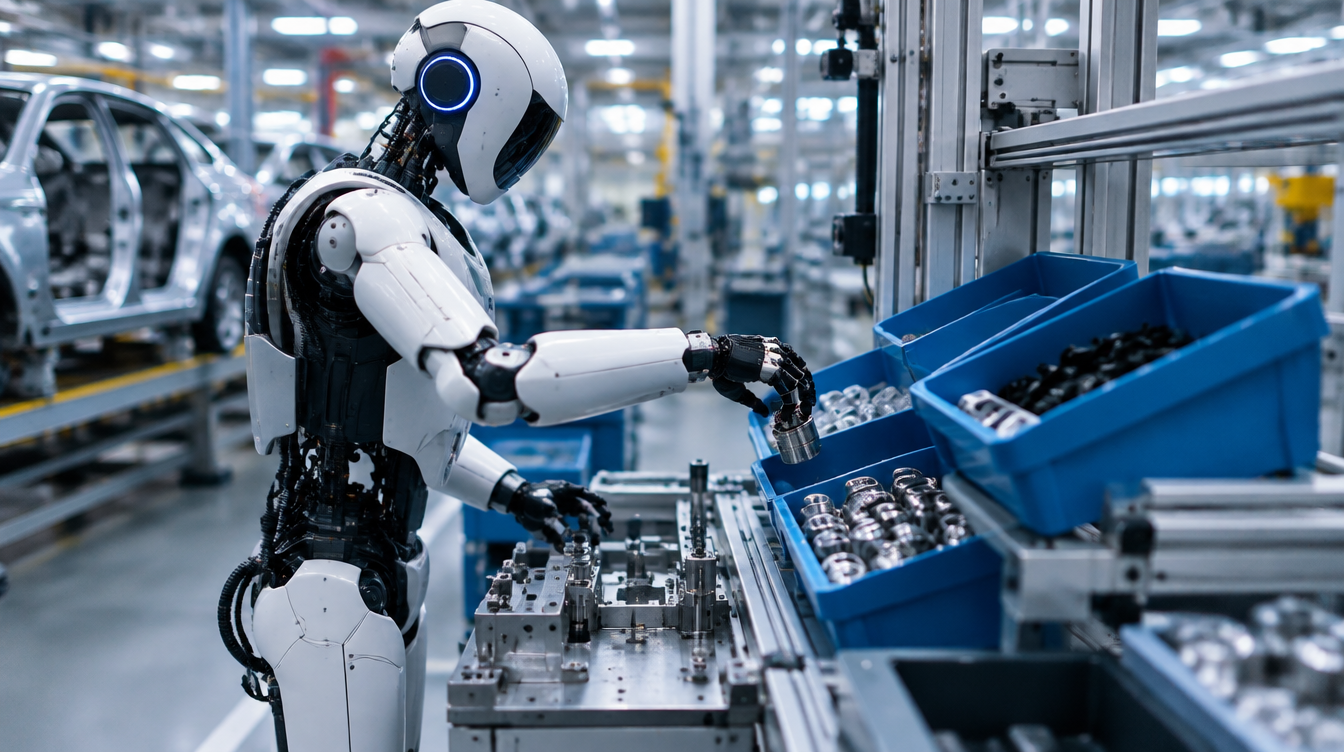
SAVANNAH, Ga. — Boston Dynamics has opened the Robotics Metaplant Application Center, a permanent Atlas training facility inside Hyundai Motor Group’s Metaplant America campus in Georgia. The company announced the opening on 21 September, describing the site as the proving ground for a deployment that Hyundai has said will eventually put 25,000 Atlas humanoids to work across Hyundai Motor and Kia plants worldwide.
Why it matters: a factory that manufactures robot behaviour
RMAC is not a production line. Boston Dynamics calls it a “Robot Behavior Factory” — real automotive parts, real fixtures and real workcells, staffed by operators whose job is to generate training data rather than vehicles. Atlas learns there by three routes: teleoperation, reinforcement learning in simulation, and handheld Universal Manipulation Interface devices that capture human demonstrations without a robot in the loop.
The first tasks are deliberately unglamorous. Atlas is being trained on parts logistics and sequencing — picking components and placing them in assembly order — work that demands bimanual handling and awkward grasps but does not touch the moving line. Boston Dynamics has said component assembly itself is a 2030 target, and that it will begin exploring aerospace, semiconductor, logistics, food and beverage and life-sciences use cases in 2027.
The numbers behind it are the real signal. A second RMAC building launching next year will expand capacity roughly tenfold. A planned U.S. manufacturing facility is sized to build up to 30,000 robots a year. Boston Dynamics is relocating staff from its Waltham, Massachusetts headquarters to Savannah and hiring locally, while separately planning a $100 million Waltham expansion that the company projects will add 1,250 jobs by 2033. Taken together, that is a company building the supply chain for a humanoid fleet before the fleet has a proven job.
“Together with Hyundai Motor Group, we are pioneering physical AI at enterprise scale… RMAC reinforces our shared ambition to create a future where robots amplify human potential by making work safer and more productive.”
Zack Jackowski, Chief Product & Technology Officer, Boston Dynamics
The open question is throughput. Every humanoid programme now claims a data flywheel; almost none has published how many hours of collected demonstration translate into one reliably autonomous task. RMAC is Boston Dynamics’ answer to that question, and it will be judged on how quickly Atlas moves from sequencing bins to touching the line.
Leave a Reply