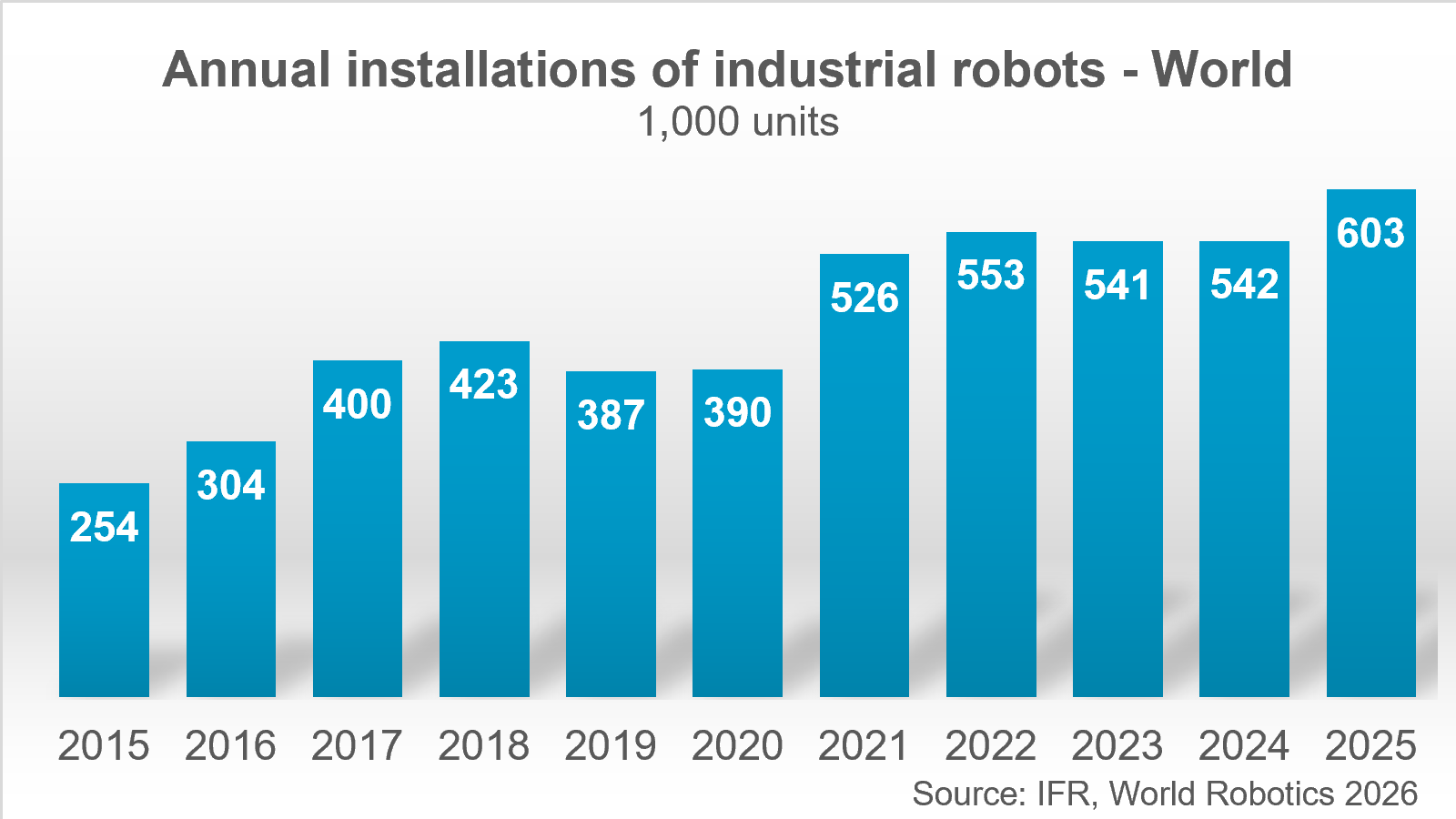
FRANKFURT — The world’s factories now operate 5 million industrial robots, a 9% increase over the previous year, according to the World Robotics 2026 report published on 24 September by the International Federation of Robotics. New installations passed 600,000 units in 2025, up 11%, and China accounted for 354,000 of them — a 20% rise that gives a single country 59% of global deployments.
By the numbers
The distance between China and everyone else is now the dominant fact in the dataset. The United States installed 38,500 robots, up 12%; Japan 36,219, down 19%; South Korea roughly 30,000, down 1%; Germany about 25,000, down 8%. China installed more than nine times as many units as the United States, and more than the rest of the world combined.
Europe is the weakest region in the report. Germany accounts for 41% of EU installations but shrank; Italy fell 11% to 7,800 units, France 8% to 4,500, Spain 15% to 4,300. The growth outside Asia is in the second tier of manufacturing economies — India added 10,500 robots, up 15%, and Brazil 4,300, up 38%, the fastest percentage gain among the countries IFR breaks out.
IFR expects 655,000 installations in 2026, another 9% increase, and 806,000 a year by 2029. That forecast matters for the humanoid and physical-AI companies now raising money against factory demand: the 5 million installed base they are pitching against is a stock of conventional arms and cells, and it is still growing at roughly 600,000 a year without them.
“Industrial automation is progressing at high speed. The new mark of five million robots operational in factories worldwide is more than double the number seven years ago.”
Jane Heffner, President, International Federation of Robotics
Leave a Reply