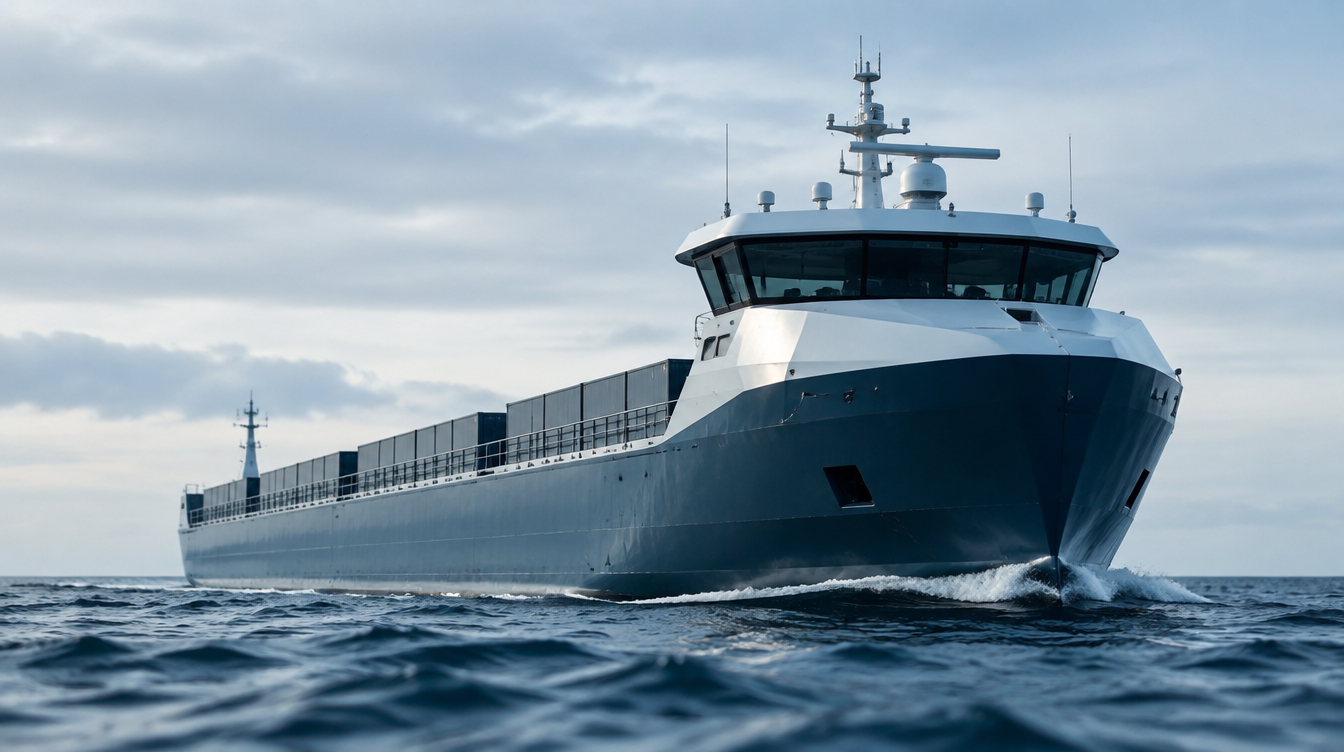
ANALYSIS — The hardest problem in marine autonomy is not the boat. Builders have been putting capable uncrewed surface vessels in the water for a decade; hulls, power systems and perception stacks are engineering problems with engineering answers. The binding constraint is legal. Who is the master of a ship with nobody on it? What will a flag state certify? And how many human beings does a statute say must be aboard regardless of what the software can do?
In May 2026 the International Maritime Organization answered the first two questions. It has not answered the third, and that gap is where the next five years of marine robotics will actually be decided.
The IMO adopted the MASS Code — Maritime Autonomous Surface Ships — at the 111th session of its Maritime Safety Committee, held 13–22 May 2026 in London. It took effect on 1 July 2026 as a non-mandatory instrument, opening what the organisation calls an experience-building phase. Work on the mandatory version begins at MSC 112 in December 2026, adoption is targeted for 1 July 2030, and the SOLAS amendments that make it binding are scheduled to enter into force on 1 January 2032. Nearly a decade of multilateral negotiation produced that calendar.
What the code actually regulates
The framework sorts vessels into four degrees of autonomy. Degree one is a conventionally crewed ship with automated decision support. Degree two is remote operation with crew still aboard. Degree three is remote control with no crew aboard at all. Degree four is a ship operating without human direction. The first two degrees describe a large slice of the existing commercial fleet and require little new law. Only degrees three and four remove people from the hull, and only those two force the regulatory questions that took ten years to negotiate.
Scope is narrower than the headlines suggest. The code applies to cargo ships as defined under SOLAS Chapter I. Passenger vessels were deliberately deferred until the experience-building phase produces evidence. Anyone forecasting autonomous ferries on the strength of this document is reading ahead of the text.
The remote master is the load-bearing idea
The single most consequential design choice in the code is that it refuses to abolish the master. A designated master remains responsible for the ship at all times, whether standing on the bridge or sitting in a Remote Operations Centre ashore — and that master must have a genuine ability to intervene, not a nominal title on a certificate. Remote Operations Centres themselves must be certified by the vessel’s flag administration.
That converts an autonomy problem into an organisational one. A company selling degree-three capability is no longer selling a vessel; it is selling a certified shore facility, a staffing model, a communications link with defined failure behaviour, and a named human who carries liability for a hull thousands of miles away. Operators who have modelled the economics purely as crew cost removed tend to discover the ROC on the other side of the ledger.
“Autonomous vessels must meet the same safety, security and environmental standards as conventional ships.”
International Maritime Organization, on the adoption of the MASS Code
Goal-based, not prescriptive
The code sets safety outcomes rather than dictating mechanisms. That is the right call for a field where the technology will turn over several times before 2032, but it pushes the burden onto class societies and flag administrations to decide what evidence is sufficient. Expect the real rulebook to be written in certification practice over the next four years, not in the code’s own text.
The American bottleneck is a headcount statute
The United States is not waiting on the IMO so much as on Congress. A 2026 Government Accountability Office review, GAO-26-108762, found that the Coast Guard currently oversees autonomous vessel design and operation using existing laws and regulations, and that various statutes establish minimum crew numbers per vessel which the agency has no broad authority to waive. GAO reports that the only mechanism allowing such waivers today sits inside an at-sea rocket recovery pilot programme. The review also flagged a shortage of domestic demonstration examples and the difficulty of harmonising US rules with the international framework. Canada, Norway and the United Kingdom have each taken different routes, ranging from compliance guidance to purpose-built regulation.
Operational work continues in parallel. The Coast Guard’s Research and Development Center in New London, Connecticut opened a cooperative research and development agreement with Saronic Technologies, published in the Federal Register on 18 November 2025, to evaluate uncrewed surface vessels for extended offshore safety and security missions — platform reliability, commanding multiple USVs from a single interface, collision avoidance consistent with international navigation rules, and connectivity.
Three things are worth watching between now and MSC 112 in December: whether any flag administration issues a Remote Operations Centre certification with published criteria, whether the experience-building phase produces genuine degree-three commercial voyages rather than escorted demonstrations, and whether US manning statutes are touched at all. 2032 is far enough out to feel abstract. It is also close enough that a vessel ordered today will be delivered into it.
Leave a Reply