Four stories from October 8–10, one theme: uncrewed systems are closing more of the kill chain at sea while warehouse robots raise real money. VideoRay rode an AEVEX-led team into a Navy mine-countermeasure prototype deal. Exail launched Neptis, a multi-USV maritime surveillance system. Shield AI pushed announced public and private money for its AI-piloted X-BAT fighter to $400 million. And Ultra said it has raised $62 million for packing robots that already work on warehouse floors. Here is what happened and why it matters.
VideoRay backs a Navy mine-countermeasure prototype after DIU challenge
AeroVironment said on October 8 that its wholly owned subsidiary VideoRay is supporting an AEVEX-led team selected for a prototype Other Transaction Agreement after the U.S. Navy and Defense Innovation Unit Mine Countermeasure Modernization Prize Challenge. BlackSea Technologies, now part of AEVEX Maritime Systems, was one of three companies awarded challenge prizes after Navy demonstrations.
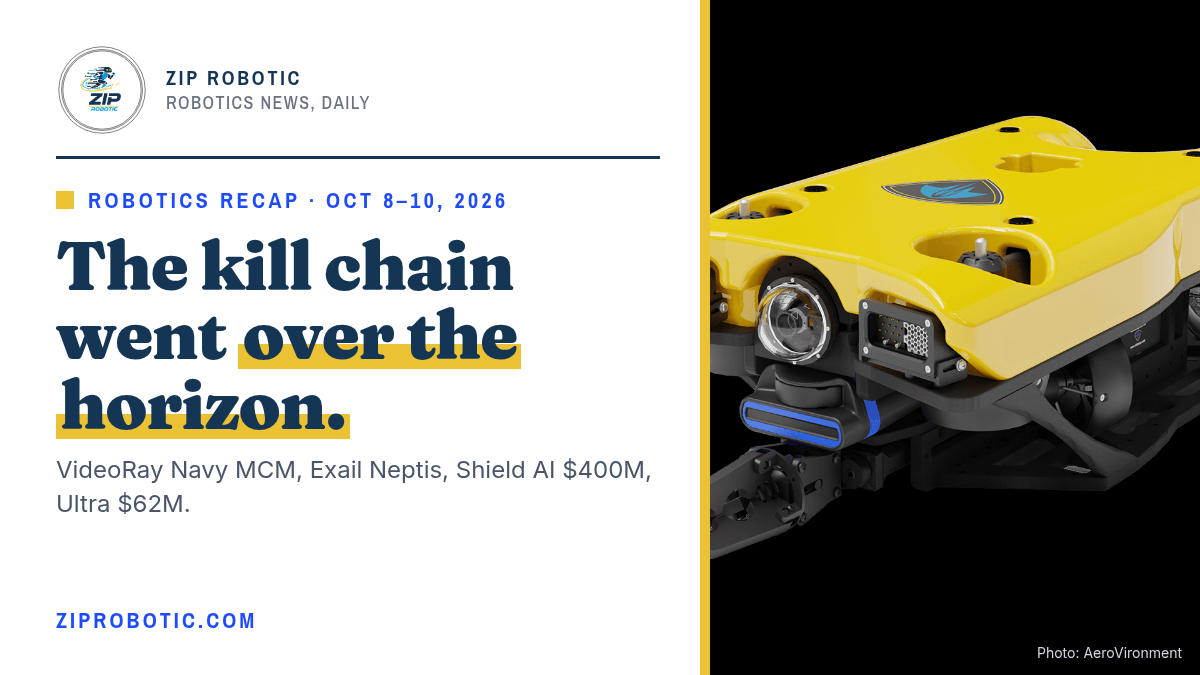
During competitive in-water testing, VideoRay showed an autonomous mine-countermeasure remotely operated vehicle launched from an AEVEX unmanned surface vessel with autonomous launch and recovery. Operators ran over-the-horizon missions from a remote ground control station while the system handled vessel transit, station keeping, ROV launch and recovery, target investigation, simulated neutralization and post-engagement assessment.
The platform is Mission Specialist Defender, AV’s modular open-architecture underwater robotic system. The Navy previously selected Defender as the base for its MK20 Defender ROV, and in 2024 awarded VideoRay a $92.6 million five-year contract for production, sustainment and development. Chris Gibson, vice president of underwater uncrewed vehicles for AV, said Mission Specialist Defender gives the Fleet a modular underwater platform that can integrate with different surface vessels and payloads so operators can run complex mine-countermeasure missions while remaining outside the threat area.
Why it matters: The Navy is buying a full detect-to-engage chain that keeps people over the horizon: USV transit, autonomous ROV launch and recovery, investigate, neutralize, assess. That is the kill chain going uncrewed, not just another ROV demo.
Exail unveils Neptis and the Oryx USV family for naval surveillance
Exail unveiled Neptis on October 9 as an integrated autonomous maritime surveillance system built to coordinate distributed autonomous assets. The stack centers on a new Oryx family of uncrewed surface vessels, defense-grade payloads and an integrated mission command-and-control system. Stated missions include intelligence, surveillance and reconnaissance, anti-submarine warfare, critical undersea infrastructure protection and counter-UAS.
Oryx variants H-8, H-9 and O-16 cover different endurance, deployment and payload needs across coastal, offshore and multi-sensor naval missions. Exail says Neptis draws on experience from its UMIS mine-countermeasures system, where multiple surface and underwater platforms, payloads and communications already run as one. Company figures in the same release: more than 1.5 million nautical miles navigated by Exail USVs, more than 300,000 operational hours, more than 90 USVs sold across the DriX and Inspector ranges, Sea State 7 survivability, and exercises with the U.S. Navy, NATO and the French Navy.
Sébastien Grall, head of maritime autonomous systems at Exail, framed the pitch as persistent presence across larger areas without a matching rise in crew numbers.
Why it matters: This is a European naval OEM selling a system of systems—multi-USV plus C2—rather than a single boat. That is how uncrewed fleets actually hold a picture at sea.
Shield AI and the U.S. government push X-BAT investment to $400 million
Shield AI said on October 8 that the U.S. Navy executed a $150 million modification to an existing Other Transaction agreement for X-BAT, an AI-piloted vertical takeoff and landing fighter. The modification is funded through the Defense Exportability Features program; Shield AI is matching with $150 million of its own capital.
In August, a separate $50 million Navy action under the Runway Independent Maritime Expeditionary Strike (RIMES) effort, plus another $50 million of Shield AI private capital, brought announced public and private commitments to $400 million. About 500 engineers at Shield AI and suppliers including GE Aerospace are building flight-test aircraft. Engine light-off and thrust-vectoring nozzle integration are done; weapons-bay aerodynamics were validated in low- and high-speed wind-tunnel tests. Hivemind is the AI pilot. Flight testing is scheduled later this year.
X-BAT is designed to take off and land vertically from ships, islands and austere sites, including CVNs, LHAs, LHDs and ESBs. Armor Harris, senior vice president of aircraft at Shield AI, said the company is testing early and often while working aircraft, mission systems, ship suitability and production in parallel. J.J. Cummings, Shield AI’s head of mission solutions for the U.S. Navy, said the runway-independent design and small deck footprint can add combat power without compromising existing carrier air wing operations.
Why it matters: Four hundred million dollars is a signal that the Navy wants AI-piloted aircraft that leave the deck without a runway—and that Shield AI is putting matching cash behind that bet.
Ultra raises $62 million for warehouse packing robots
On October 9, Fortune and SiliconANGLE reported Ultra’s announcement that it has raised $62 million across two rounds: a $50 million Series A led by Framework Ventures and an earlier $12 million seed led by Y Combinator and NextView. Fortune also notes Y Combinator participation in the Series A and a deeper tie-up with Physical Intelligence for on-site robot AI.
Ultra’s OP1 Operator, per the company site and those reports, targets warehouse packing, sorting and kitting. It is a dual-arm style system with vertical reach up to 10 feet, plugs into a standard 120V outlet, rides locking caster wheels that workers move by hand, and claims setup in hours. Fortune attributes to Ultra that its robots have packed more than 500,000 orders. The commercial model is robots-as-a-service: an up-front integration fee plus a monthly hardware and software fee. CEO and co-founder Jon Miller Schwartz told SiliconANGLE that the robots changing the world are the ones doing valuable work for real people, right now.
Why it matters: While humanoids get the headlines, Ultra is selling monthly-fee arms that already pack orders. That is the warehouse side of the same autonomy story—less spectacle, more invoices.
The takeaway
Strip the press language and the week says this: at sea, uncrewed surface and underwater systems are being wired into real detect-to-engage and surveillance loops; on the flight deck, AI-piloted VTOL fighters just got another huge check; on the warehouse floor, packing robots raised growth capital for work that already ships. Watch for the Navy’s MCM prototype path after the VideoRay/AEVEX trials, first Neptis customer talk, X-BAT flight test later this year, and how fast Ultra converts RaaS installs into repeat revenue.
Sources
- AeroVironment: AV’s VideoRay Selected as Subcontractor for Navy Mine Countermeasure Prototype Effort (Oct 8, 2026)
- Exail: Exail unveils Neptis, a new model of maritime surveillance built on distributed autonomy (Oct 9, 2026)
- Shield AI via PR Newswire: Shield AI and U.S. government investment in X-BAT reaches $400 million (Oct 8, 2026)
- SiliconANGLE: Warehouse robot maker Ultra Robotics bags $62M (Oct 9, 2026)
- Fortune: Ultra raises $62 million… tie-up with Physical Intelligence (Oct 9, 2026)
- Ultra: OP1 Operator product / specs (first-party)
Leave a Reply