By Zip Robotic · October 14, 2026
Four stories from October 11–13, one theme: robots under murky water, on shipyard floors, learning from video, and buying European sortation. CSIRO and partners are towing a camera vehicle behind an uncrewed boat to map seagrass where divers and clear water fail. South Korea cleared 20 Robros bipedal humanoids for live factory tests beside workers, including a Hyundai shipyard. Google DeepMind’s Gemini 4 Argon watched a human play cornhole, wrote its own sim, and put seven straight shots on Apptronik’s Apollo. And Symbotic bought Bremen’s cellumation for the celluveyor sortation deck. Here is what happened and why it matters.
CSIRO tows a camera under murky water for seagrass
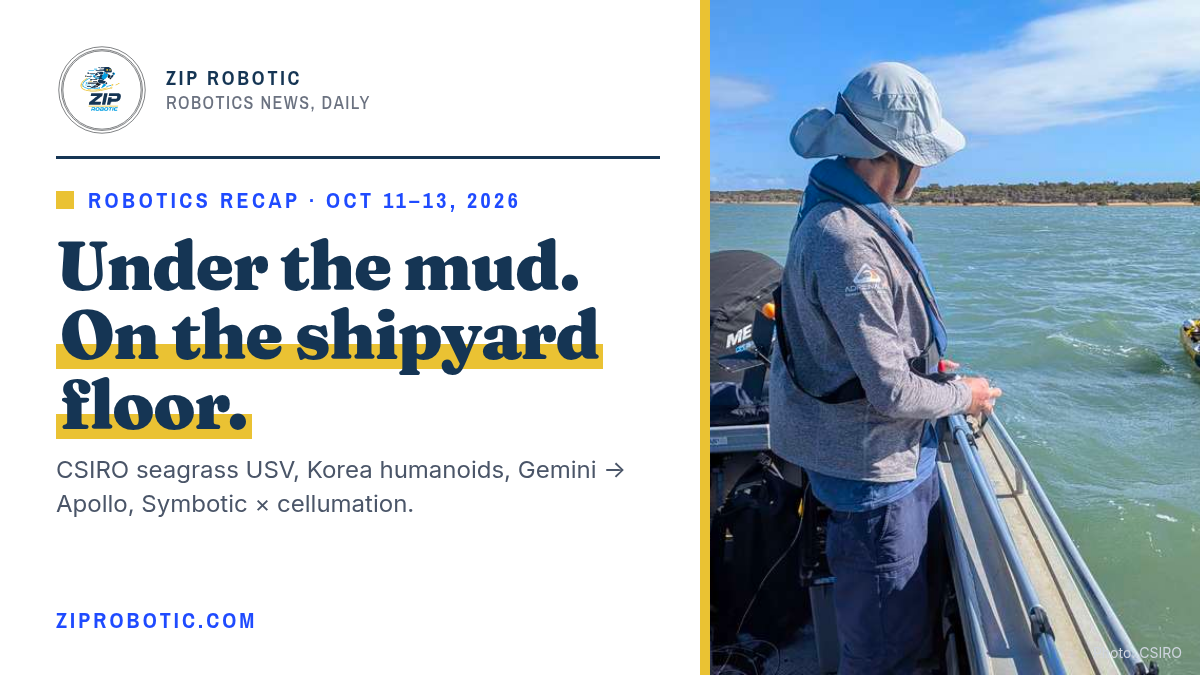
CSIRO published a partner release on October 13 on trials of a towed underwater vehicle with CQUniversity’s Coastal Marine Ecosystems Research Centre and the Great Barrier Reef Foundation. The tethered system is built to collect high-definition imagery and environmental data just above the seabed in turbid coastal water, where traditional survey methods struggle.
CSIRO Principal Research Engineer Dr Torsten Merz describes a robotic pair: an uncrewed surface vessel and a towed underwater vehicle. Images are recorded and processed on board the USV and sent to users by radio link; AI-generated analysis is meant to speed seagrass monitoring and assessment. CMERC Director Professor Emma Jackson said researchers can position the camera just above the seabed and tow it over long distances while collecting georeferenced imagery and data. Field work includes Gladstone deployments. In intertidal areas, the TUV can be paired with aerial drone surveys for ground-truthing without walking long distances across sensitive habitat. A final project report is expected later this year. Scaling SeaGrow funding comes from the Australian Government’s Reef Trust and the Great Barrier Reef Foundation.
Why it matters: Marine science still loses coverage in brown water. A USV that tows eyes along the seabed is a practical autonomy story—restoration and carbon-storing meadows, not just warships.
Korea clears 20 Robros humanoids for factory floors next to people
Seoul Economic Daily reported on October 13 that South Korea’s Ministry of Trade, Industry and Energy granted a regulatory sandbox testing exemption to Robros after the sixth Industrial Convergence Regulatory Sandbox Review Committee meeting of 2026. Twenty AI-equipped bipedal humanoids will work at Nepes, Sungwoo Hitech, HD Hyundai Samho and Delivery Lab, in spaces shared with or adjacent to human workers.
Task mix: cleaning contaminants from circular semiconductor packaging components at Nepes; positioning auto body parts at Sungwoo Hitech; stacking scaffolding brackets that secure elevated work platforms to a ship’s hull at HD Hyundai Samho; moving refrigerated logistics packaging at Delivery Lab. Safety rules written for fenced, stationary industrial robots did not fit mobile humanoids. The government approved the test on the condition that Employment and Labor risk assessments and risk-reduction measures are carried out; the data is meant to inform new safety standards for wider industrial adoption. Trade Minister Kim Jung-kwan said regulation struggles to keep up with AI and that institutional bottlenecks need to come down fast.
Why it matters: This is a live regulatory path for humanoids sharing floors with people—and one of the four sites is a shipyard stacking hull scaffolding. That is manufacturing autonomy with a marine-adjacent footprint.
Gemini 4 Argon teaches Apollo cornhole from one video
Google launched Gemini 4 Argon on October 13. In the same post, Google says Argon scores 87% on the Embodied Reasoning (ERQA) benchmark using pure reasoning. To show robotics skill transfer, Google describes an internal test: Argon watched a raw video of a human playing cornhole, mapped the environment’s spatial coordinates, calculated the whole-body joint movements required, autonomously built the simulation code, and transferred the behavior to Apptronik’s Apollo humanoid. In a real-world trial, Apollo sank seven consecutive shots. Google calls the pipeline “Video-to-Sim-to-Real” and says it can compress weeks of manual simulation modeling into a few hours. A companion Google Developers Blog post the same day walks through Argon workflows across robot control, Real2Sim, physical understanding and self-improvement.
Why it matters: If ordinary video becomes a training ground because the model writes the sim itself, the long tail of robot skills stops needing a hand-built world for every new task.
Symbotic buys cellumation and the celluveyor
Symbotic Inc. announced on October 13 that it has acquired cellumation GmbH of Bremen, Germany, creator of the celluveyor—a patented, software-driven sortation platform. The celluveyor is made of hundreds of independently controlled omnidirectional cells; each cell can move an item in any direction, so the surface decides where products should go while moving them. Symbotic says the tech can deliver more throughput and handle a wider product mix in a fraction of the space traditional conveyors need, and that it is a key enabler for denser inbound and outbound robotic cells.
cellumation will keep its name and Bremen headquarters, serving its existing global customers while Symbotic accelerates European expansion. Co-founders Dr.-Ing. Hendrik Thamer (CEO) and Dr.-Ing. Claudio Uriarte (CTO) remain with the company. Symbotic Chairman and CEO Rick Cohen tied the deal to prior acquisitions of ARMS Innovations and Fox Robotics and said celluveyor will be sold both as a standalone product and integrated into Symbotic systems. Financial terms were not disclosed.
Why it matters: A major U.S. warehouse robotics public company is buying European omnidirectional sortation hardware—and keeping the Bremen team as a product company, not just an IP tuck-in.
The takeaway
Strip the press language and the stretch says this: under turbid water, a USV+TUV stack is trying to see seagrass at scale; on Korean factory and shipyard floors, regulators just opened a shared-space humanoid trial; in the lab, a frontier model wrote its own sim from a backyard game video and put shots on a humanoid; in the warehouse, Symbotic paid for a denser sortation deck out of Bremen. Watch for CSIRO’s year-end TUV performance report, how Korea’s sandbox data rewrites robot safety rules, whether Video-to-Sim-to-Real shows up outside demo sports, and how fast celluveyor lands inside Symbotic cells versus staying a standalone European product.
Sources
- CSIRO: Eyes beneath the surface (Oct 13, 2026)
- Seoul Economic Daily: Korea Clears First Factory Test of 20 Humanoid Robots (Oct 13, 2026)
- Google: Gemini 4 Argon is now available for everyone (Oct 13, 2026)
- Google Developers Blog: Gemini 4 Argon for Robotics (Oct 13, 2026)
- Symbotic: Announces Acquisition of cellumation (Oct 13, 2026)
- cellumation: New Chapter — Symbotic acquires cellumation (company mirror)
Leave a Reply