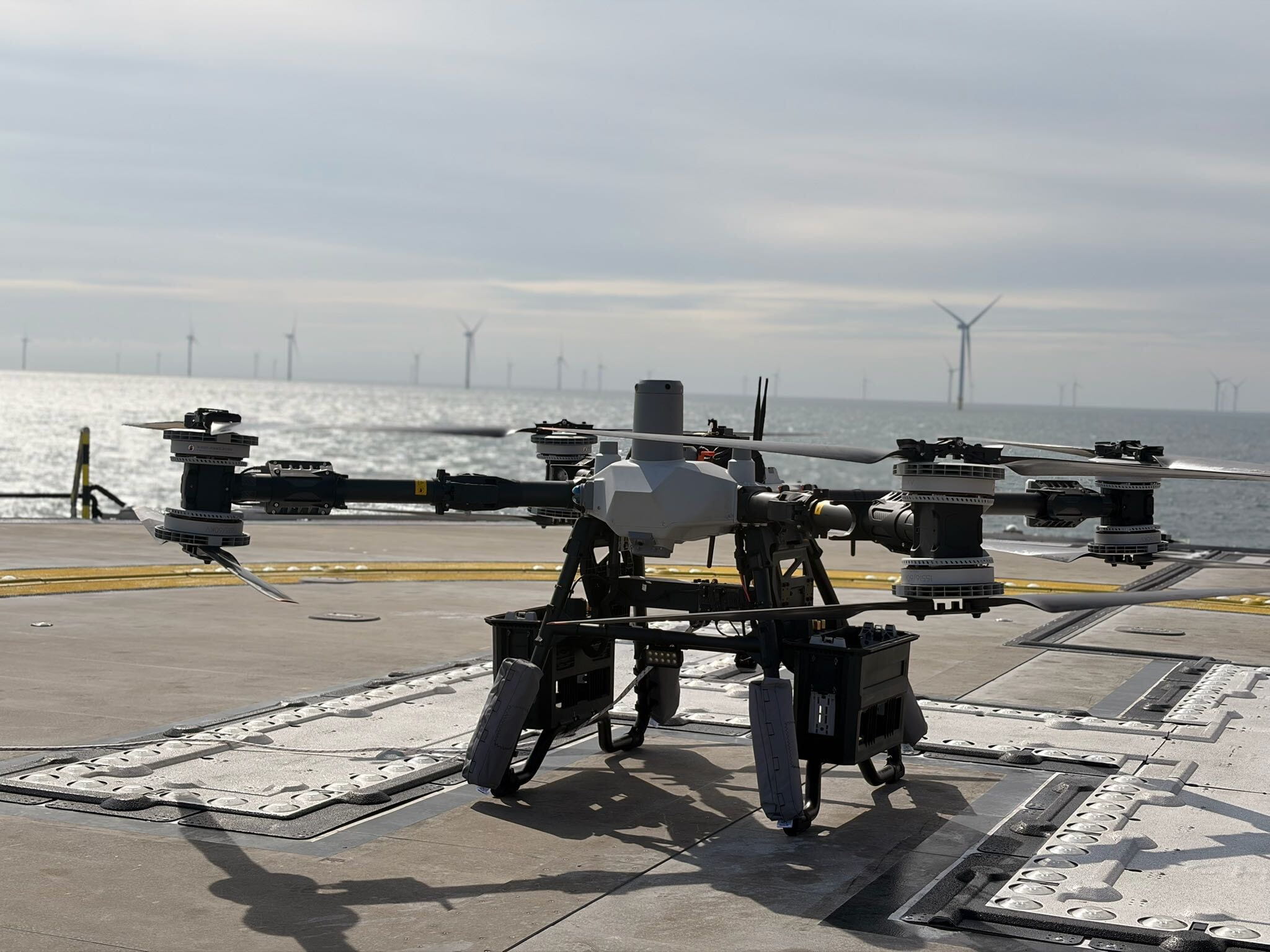
LONDON — Ørsted has completed a four-week trial at its Hornsea 2 offshore wind farm in which cargo drones operated by Skyports Drone Services flew maintenance kits weighing 55 to 65 kg out to turbines in the North Sea. The developer announced the result on 7 October. During the trial the team also flew its first beyond-visual-line-of-sight delivery inside the wind farm, covering roughly 4 km, planned and monitored from a service operations vessel at sea rather than from shore.
Why it matters
The economics of offshore wind maintenance are dominated by boats. Getting a bag of tools and spare parts to a turbine normally means a crew-transfer vessel trip, a crane lift and a weather window. Ørsted’s framing is that a drone with a 65 kg payload collapses that chain for a large share of routine jobs: kits were delivered to turbines ahead of technicians arriving, and collected again afterwards and returned to the vessel.
The operational detail that matters most is the automatic hook. Skyports fitted a load-collection mechanism that picks up and releases the bag without a person attaching it by hand, which is what turns a demonstration flight into something that can run repeatedly during a working day. Ørsted says the daily presence of the aircraft let it absorb ad-hoc requests as well as scheduled work — the difference between a scripted trial and a service.
“As we had a daily presence, we were able to cater for a variety of ad-hoc flight requests. We were able to cover both planned and reactive works.”
Richard McCrilley, project lead, Ørsted
The UK Civil Aviation Authority supported the airspace approvals, and its head of technical strategy for future safety and innovation, Ed Clay, said continued industry collaboration and evidence gathering would be vital — regulator language for a capability that is not yet routinely permissioned. Ørsted operates 11 GW of installed offshore wind capacity with a further 7.2 GW under construction, so a per-turbine saving scales.
What the release does not contain is a number for any of the savings. Ørsted says fewer vessel trips should cut fuel use, emissions and operating cost and improve turbine uptime, but publishes no figures for flights completed, vessel trips displaced, fuel saved or cost per delivery, and does not name the aircraft type flown. There is no announced move from trial to contracted service.
Leave a Reply