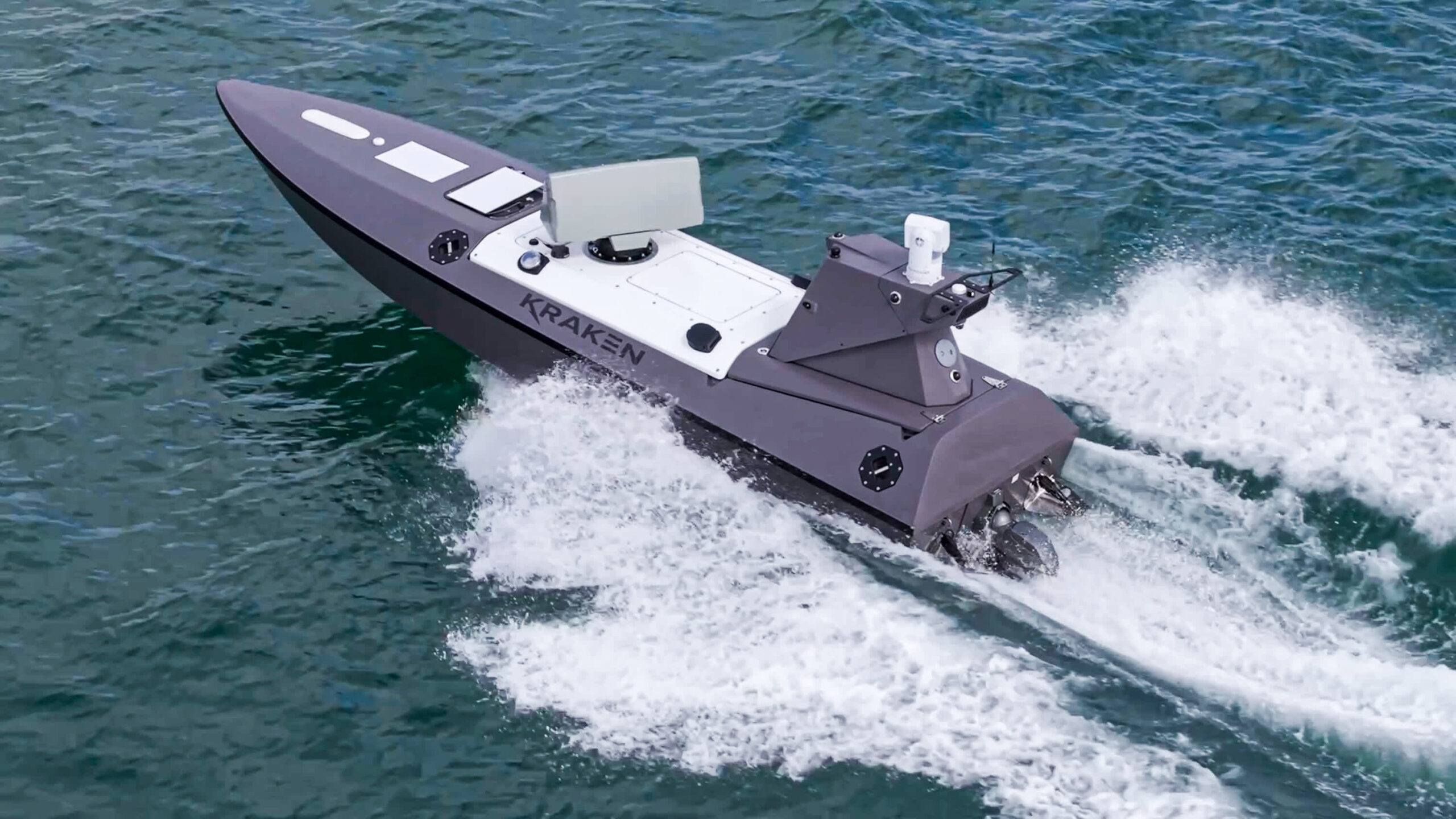
FAREHAM, England — Saab UK and Kraken Technology Group have installed a Giraffe 1X 3D radar in the modular payload bay of Kraken’s K3 Scout uncrewed surface vessel, producing an experimental “drone seeker” boat the two companies say went from concept to working prototype in less than seven months. The pair announced the prototype on 5 October, after a series of sea trials to check radar performance in a maritime environment. Both the radar and the hull are built in Fareham, on England’s south coast.
By the numbers
Kraken lists the K3 Scout at 8.4 metres length overall, a 55-knot maximum speed, 600 kg of payload capacity and 650 nautical miles of range at 25 knots, with endurance of up to 30 days depending on mission. Saab rates the complete Giraffe 1X system at under 150 kg, of which 100 kg is topside. That weight budget is the engineering reason the pairing works: a full 3D radar fits inside a quarter of the boat’s payload margin.
What the radar contributes is small-target detection. Saab markets the 1X as able to pick up a UAV “lighter than a milk carton” at 4 km while refreshing its entire search volume every second. Bolted to a low-signature hull that can loiter off a port, an offshore wind farm or a tanker anchorage with nobody aboard, that turns a fixed air-defence mast into a movable early-warning picket — the capability gap that drone attacks on shipping in the Red Sea and on Baltic infrastructure have made expensive to ignore.
“Exactly what the K3 SCOUT was designed to do: integrate with mission-relevant payloads.”
Mal Crease, CEO and founder, Kraken Technology Group
The commercial context is a company scaling fast. Kraken raised $175 million at a $1 billion valuation in July 2026, began K3 Scout series production at Rheinmetall’s Hamburg site in April, and says it is building toward an output of 1,000 vessels a year. Saab UK, for its part, took a UK Ministry of Defence Giraffe 1X order worth roughly £24 million in April 2026 and delivered its 100th unit of the radar in May.
Both companies are explicit that the vessel remains experimental. No customer, order, delivery schedule or contract value was announced, and neither release gives a detection range for the radar as fitted to the boat, or results from the sea trials beyond the fact that they happened.
Leave a Reply